6. Properties of Substances – Exercises

Exercise
(1) Choose the correct option and complete the sentences.
(a) Ice is the ............ state of water. (solid, liquid, gas)
(b) When light rays fall on an opaque substance, ............ (Some light passes through, all light passes through, light does not pass through)
(c) Oil floats on water; this means the density of oil is ............ water. (less than, equal to, greater than)
Ans.
(a)
Ice is the solid state of water.
(b)
When light rays fall on an opaque substance, light does not pass through.
(c)
Oil floats on water; this means the density of oil is less than water.
(2) Which of the following statements represent the solid and gaseous states respectively?
(a) Particles are very close to each other and hold each other tightly.
(b) Particles are slightly further apart and loosely bound.
(c) Particles scatter everywhere in the available space.
Ans.
1
(a) represents the solid state.
2
(c) represents the gaseous state.
(3) Observe the relationship in the first pair and complete the second pair.
(a) Glass : Transparent substance :: Butter paper : ............
(b) Solid : Has a specific shape :: Liquid : ............
Ans.
(a)
Glass : Transparent substance :: Butter paper : Translucent substance.
(b)
Solid : Has a specific shape :: Liquid : Takes the shape of its container.
(4) Stand close to the mirror and look at your face. Now exhale onto the mirror. What difference do you see? What could be the reason for it?
Ans.
1
The mirror becomes foggy, and the face cannot be seen clearly.
2
Water vapour in our breath changes into tiny water droplets on the mirror.
3
After some time, the droplets evaporate and the mirror becomes clear again.
(5) There are two boxes of the same size. One is filled with stones and the other with small pieces of sponge. Without opening the boxes, how will you identify which box contains what?
Ans.
1
I will lift both boxes and compare their weight.
2
The heavier box will contain stones, while the lighter box will contain sponge pieces.
(6) Identify the group in which all the substances are in the liquid state.
Ans.
(b) Milk, oil, sherbet
(7) From the following, which are transparent and which are translucent? Make two separate lists. Piece of glass, butter paper, notebook-cardboard, plastic sheet, sandpaper, oiled paper.
Ans.
1
Transparent: Piece of glass, plastic sheet.
2
Translucent: Butter paper, oiled paper.

(8) Onion fritters (Kanda-bhaji) are being made in the neighbor’s house and you came to know this without going there. What is the connection between this and the states of matter?

Solution
  • While frying bhajis, fragrant substances evaporate and mix with air.
  • In the gaseous state, these particles spread in all directions.
  • Therefore, we can smell the bhajis even from a distance.
  • This is due to a change in the state of matter.

(9) If a liquid has a volume of 3 ml and a mass of 7.5 grams, what will be its density?

Solution

Given: Mass = 7.5 g, Volume = 3 ml

Density = Mass Volume = 7.5 3 = 2.5 g/ml

Therefore, the density of the liquid is 2.5 g/ml.

(10) Nowadays, a different type of glass is used for windows in newly constructed buildings. From the outside during the day, these look like coloured mirrors. Objects inside the room cannot be seen from the outside. However, those inside can see outside through the window. What should these glasses be called: Transparent, Opaque or Translucent?

Solution
  • Light can pass through these glasses to some extent.
  • People inside can see outside, but people outside cannot clearly see inside.
  • They are neither completely transparent nor completely opaque.
  • Therefore, these glasses are translucent.

(11) A thin dark film is stuck to car windows. What happens due to this?

(a) The glass becomes more transparent.
(b) The glass becomes opaque.
(c) The glass becomes translucent.
Solution

Correct Option: (c) The glass becomes translucent.

Note: The dark film allows only some light to pass through. Therefore, the glass becomes translucent.

(12) Which one will have a greater volume, 1 kg cotton or 1 kg of iron?

Solution
  • Both have the same mass of 1 kg.
  • Cotton is less dense than iron.
  • Therefore, 1 kg of cotton has a greater volume.

(13) If 1 kg of cotton and 1 kg of iron are placed in the two pans of a balance scale, which pan will go down?

Solution
  • Both cotton and iron have the same mass of 1 kg.
  • Therefore, both pans will remain balanced.
  • No pan will go down.
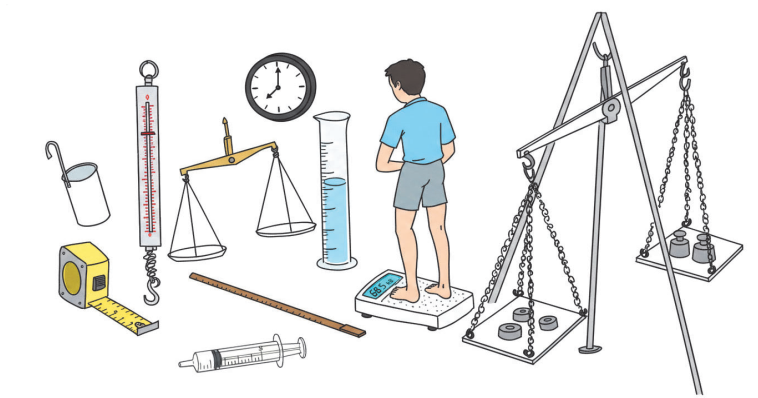
(14) Several measuring instruments are shown in the picture.
➢ Make two separate groups of instruments that measure volume and mass.
➢ Which of these instruments must be transparent? Why?
Solution
(a) Instruments for measuring volume and mass:
Instruments for measuring volume Instruments for measuring mass
Measuring cylinder Spring balance
Measuring scale Two-pan balance
Injection syringe Weighing scale
Metre tape Large balance
(b) Which instruments must be transparent? Why?
The measuring cylinder and injection syringe must be transparent so that the level and volume of the liquid can be seen clearly.

Leave a Comment

Your email address will not be published. Required fields are marked *

error: Content is protected !!