
| Group A | Group B |
|---|---|
| (1) Aquatic | (i) Frog |
| (2) Living in muddy wetlands | (ii) Swan |
| (3) Amphibian | (iii) Wild buffalo |
| (4) Floating on the surface of water | (iv) Fish |
- Aquatic — Fish
- Living in muddy wetlands — Wild buffalo
- Amphibian — Frog
- Floating on the surface of water — Swan
Fish — It is an aquatic animal; the others are terrestrial animals.
Coriander — It is a herb; the others are trees.
Cockroach — It is an insect; the others are mammals.
Moong — It is a dicotyledonous seed; the others are monocotyledonous seeds.
True.
False — Plants with fibrous roots collapse easily in a light storm.
False — Mango trees bear flowers, and mango fruits develop from these flowers.
False — Polar bears live in snowy regions.
False — Snakes are reptiles, not amphibians. They cannot breathe in water.
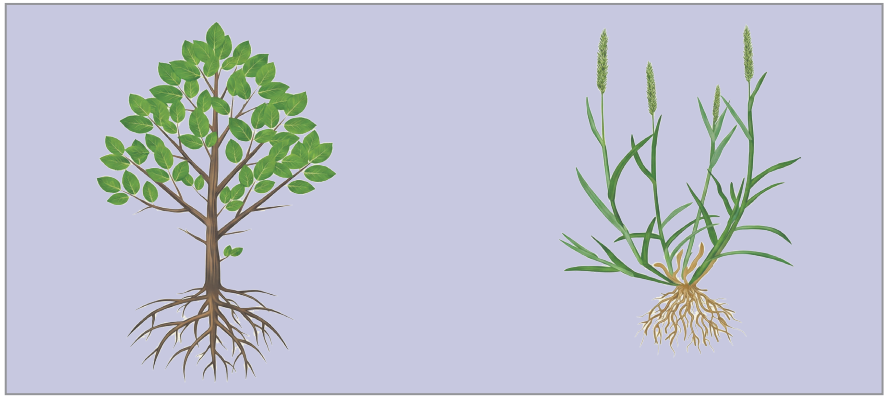
- ✓ The plant on the left has a tap root and leaves with reticulate venation.
- ✓ The plant on the right has fibrous roots and leaves with parallel venation.
- ✓ Plants with tap roots and reticulate venation are dicotyledonous plants.
- ✓ Plants with fibrous roots and parallel venation are monocotyledonous plants.
We can consider the stem, branches and height of the plant.
- Trees have a thick, hard, woody stem, and their branches grow from the upper part.
- Shrubs have many branches near the base and are usually of medium height.
- Herbs have soft, green, weak stems and are usually short in height.
Based on these characteristics, we can determine whether a plant is a tree, a shrub or a herb. The holy basil plant is classified as a shrub.
| Monocotyledonous (Monocot) Plants | Dicotyledonous (Dicot) Plants |
|---|---|
| The seeds contain one cotyledon. | The seeds contain two cotyledons. |
| They have fibrous roots. | They have tap roots. |
| The leaves show parallel venation. | The leaves show reticulate venation. |
| Examples: Rice, Wheat, Banana. | Examples: Sunflower, Mango, Neem. |
(Monocot)
(Dicot)
Rice, Wheat, Banana.
Sunflower, Mango, Neem.
- 1 A duck has an aquatic habitat because it lives and swims in water.
- 2 Its webbed feet help it swim easily.
- 3 Its oily, waterproof feathers keep its body dry.
- 4 It finds food, such as small fish and aquatic plants, mainly in water.
- 5 It breathes air through its nostrils and lungs, not oxygen dissolved in water.
- 1 Dog: Terrestrial habitat (land).
- 2 Cat: Terrestrial habitat (land).
- 3 Pigeon: Aerial habitat (air and trees).
- 4 Fish: Aquatic habitat (water).
- 5 Ant: Terrestrial habitat (land).
Found in: Grasslands of Maharashtra, especially around Solapur and Ahmednagar.
Threats: Loss of grassland habitat and other human activities.
Protection: Great Indian Bustard Wildlife Sanctuary has been established for its conservation.
Found in: Forest areas of Maharashtra.
Threats: Loss and destruction of forest habitat.
Protection: Forest conservation and protection of its natural habitat are important.
Found in: Different forest and open areas of Maharashtra.
Threats: Poisoning, harmful veterinary drugs and loss of habitat.
Protection: Vulture conservation programmes and protection of nesting areas are needed.
Found in: Coastal areas of Maharashtra.
Threats: Pollution, fishing activities and disturbance to nesting sites.
Protection: Protection of beaches and nesting sites helps conserve these turtles.
Found in: Freshwater rivers and streams.
Threats: Water pollution, dams and destruction of river habitats.
Protection: Clean rivers and protection of freshwater habitats are necessary.