
Exercise
QUESTION
(1)
Choose the correct option by matching the right pairs from the ‘A’ and ‘B’ Groups.
Column ‘A’
Column ‘B’
(1) Tropic of Cancer
(A) 23°30′ South
(2) Tropic of Capricorn
(B) 23°30′ North
(3) The Antarctic Circle
(C) 66°30′ North
(4) The Arctic Circle
(D) 66°30′ South
Options
(a) 1 – A, 2 – B, 3 – C, 4 – D
(b) 1 – B, 2 – A, 3 – D, 4 – C
(c) 1 – C, 2 – D, 3 – A, 4 – B
(d) 1 – D, 2 – C, 3 – B, 4 – A
✓
Solution
Correct Option
(b)
1 – B, 2 – A, 3 – D, 4 – C
QUESTION
(2)
Identify which are the true statements about latitudes and longitudes and choose the correct option.
(1)
The 0° latitude divides the Earth into two equal hemispheres.
(2)
The 0° and the 180° longitudes together divide the Earth into the eastern and the western hemispheres.
(3)
The length of all the longitudes is equal.
(4)
All latitudes are of equal length.
Options
(a) 1, 2, 4
(b) 1, 2, 3
(c) 1, 2, 3, 4
(d) 1, 2, 4
✓
Solution
Correct Option
(b) 1, 2 and 3 are true.
QUESTION
(3)
Examine the following statements, correct the incorrect statements and rewrite.
1.
All longitudes converge at the north and the south poles.
2.
The consecutive longitudes are parallel to each other.
3.
The 180° longitude is the base longitude.
4.
The base longitude divides the Earth into the northern and southern hemispheres.
5.
The Equator is also called the Great Circle.
✓
Solution
1.
Correct
All longitudes converge at the north and the south poles.
2.
Incorrect
Correct Statement
The consecutive longitudes are not parallel to each other. All the longitudes meet at the north pole and the south pole.
3.
Incorrect
Correct Statement
The 180° longitude is not the base longitude. The 0° longitude is the base longitude.
4.
Incorrect
Correct Statement
The Equator divides the Earth into the northern and southern hemispheres.
5.
Correct
The Equator is also called the Great Circle.
QUESTION
(B)
Identify the odd feature with the help of a Globe.
(1)
(a) The Tropic of Cancer
(b) The Tropic of Capricorn
(c) The Equator
(d) The Base Longitude
(2)
(a) 90° East
(b) 90° West
(c) 5° East
(d) 90° North
(3)
(a) Brazil
(b) India
(c) Japan
(d) China
(4)
(a) Moscow
(b) Delhi
(c) Sydney
(d) Tokyo
✓
Solution
(1)
Odd feature: (d) The Base Longitude
(2)
Odd feature: (d) 90° North
(3)
Odd feature: (a) Brazil
(4)
Odd feature: (c) Sydney
QUESTION
(C)
The figure below represents one hemisphere. Answer the following questions by observing the figure.

QUESTION
D)
Explain the difference between the latitudes and the longitudes with the help of a figure.
✓
Solution
| Latitudes | Longitudes |
|---|---|
| (1) Imaginary circles drawn at a distance of one degree difference from each other, parallel in the east-west direction, are known as latitudes. | (1) The semicircular imaginary lines drawn from the center of the Earth at an equal angular distance from each other in the north-south direction are called longitudes. |
| (2) Latitudes are parallel to each other and never meet. | (2) Longitudes meet at the North Pole and the South Pole. |
QUESTION
E)
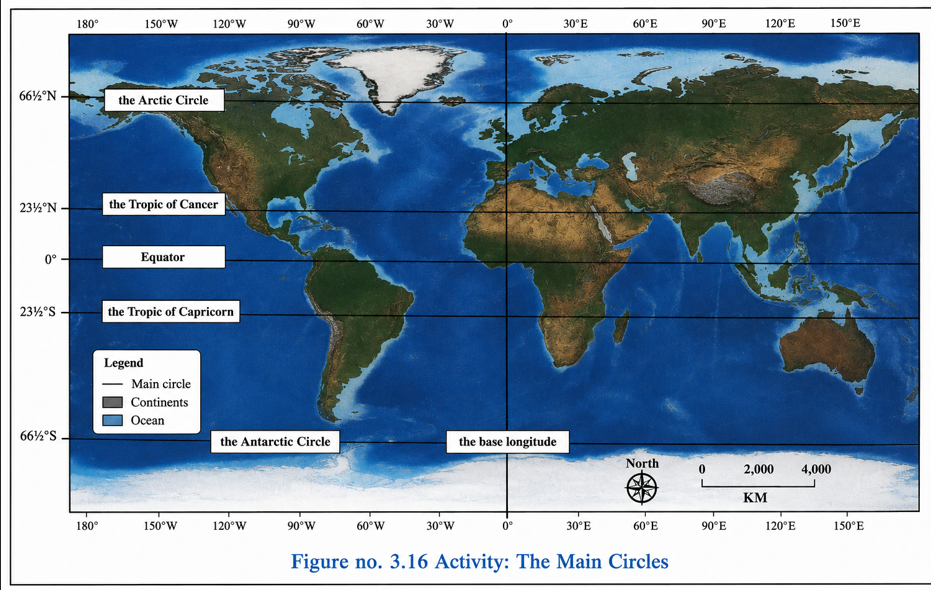
Choose the correct option from the bracket and write in the boxes of figure no. 3.16 by observing the figure.
(Equator, the Arctic Circle, the Tropic of Cancer, the base longitude, the Tropic of Capricorn, the Antarctic Circle)
✓
Solution
QUESTION
F)
Answer the following questions based on the observation of Figure no. 3.13.
✓
Solution
1.
From which oceans and continents do all the longitudes pass?
Ans. All the longitudes pass through all the oceans—the Atlantic Ocean, Pacific Ocean, Indian Ocean, Arctic Ocean and Antarctic Ocean. They also pass through all the continents—Asia, Africa, Europe, North America, South America, Australia and Antarctica.
2.
From which oceans and continents does the Equator pass?
Ans. The Equator passes through the Pacific Ocean, Atlantic Ocean and Indian Ocean, and through South America and Africa.
3.
From which continents and oceans does the Prime Meridian pass?
Ans. The Prime Meridian passes through Europe, Africa and Antarctica, and through the Arctic Ocean, Atlantic Ocean, Southern Ocean and Antarctic Ocean.
4.
From which continents do both the 0° circles pass?
Ans. Both the Equator (0° latitude) and the Prime Meridian (0° longitude) pass through Africa.
5.
How many latitudes on the globe are circular in shape?
Ans. 179 latitudes are circular in shape. The remaining two are in point form.