
Important Committees of the Constituent Assembly
| Name of the Committee | Head of the Committee |
|---|---|
|
Constituent Assembly Rules Committee (Steering Committee) |
Dr. Rajendra Prasad |
| Drafting Committee | Dr. Babasaheb Ambedkar |
| Union Powers Committee | Pandit Jawaharlal Nehru |
|
Fundamental Rights and Minorities Committee |
Sardar Vallabhbhai Patel |
Simple Explanation
The textbook gives some important committees of the Constituent Assembly and tells us who headed each committee. The Constituent Assembly Rules Committee, which was also called the Steering Committee, was headed by Dr. Rajendra Prasad.
The Drafting Committee was headed by Dr. Babasaheb Ambedkar. The Union Powers Committee was headed by Pandit Jawaharlal Nehru. The Fundamental Rights and Minorities Committee was headed by Sardar Vallabhbhai Patel.
Thus, the table tells us the names of these important committees and the leaders who headed them.
The Drafting Committee was established to prepare a draft of the Constitution by collectively considering the reports submitted by these and all other committees.
Simple Explanation
The Drafting Committee was formed to prepare the draft of the Constitution. To prepare this draft, it considered the reports given by the committees listed above as well as the reports submitted by all the other committees. In this way, the work and suggestions of the different committees were considered together while preparing the draft Constitution.
2.3.1 The Drafting Committee
The Drafting Committee was the most important committee responsible for the creation of the Indian Constitution. This committee was established on 29th August 1947. By reviewing the reports received from various committees, the Drafting Committee prepared a concrete draft that gave the Constitution its final form. The final draft thus prepared was adopted by the Constituent Assembly on 26th November 1949.
Simple Explanation
The Drafting Committee was the most important committee for creating the Indian Constitution. It was established on 29th August 1947.
The committee studied and reviewed the reports received from the different committees. After considering these reports, it prepared a clear and complete draft of the Constitution. This draft gave the Constitution its final form.
The final draft prepared by the Drafting Committee was then adopted by the Constituent Assembly on 26th November 1949.
Members of the Drafting Committee :
The Drafting Committee consisted of a total of seven members, including the Chairman.
- Dr. B. R. Ambedkar (Chairman)
- Shri N. Gopalaswami Ayyangar
- Shri Alladi Krishnaswami Ayyar
- Dr. K. M. Munshi
- Shri Mohammed Saadulla
- Shri B. L. Mitter (Shri K. N. Madhava Rao was appointed following his resignation.)
- Shri D. P. Khaitan (Shri T. T. Krishnamachari was appointed following his death.)
Simple Explanation
The Drafting Committee had a total of seven members, including its Chairman. Dr. B. R. Ambedkar was the Chairman of the committee.
The other members were Shri N. Gopalaswami Ayyangar, Shri Alladi Krishnaswami Ayyar, Dr. K. M. Munshi and Shri Mohammed Saadulla.
Shri B. L. Mitter was also a member. After his resignation, Shri K. N. Madhava Rao was appointed in his place.
Shri D. P. Khaitan was also a member. After his death, Shri T. T. Krishnamachari was appointed in his place.
Therefore, the textbook gives the names of all seven members and also explains the changes that took place in the membership of the committee.
Word Meanings
| English Word / Phrase | मराठी अर्थ | हिंदी अर्थ |
|---|---|---|
| Constituent Assembly The body formed to prepare the Constitution |
घटनासभा – संविधान तयार करणारी सभा | संविधान सभा – संविधान तैयार करने वाली सभा |
| Committee A group formed to do a particular task |
समिती – विशिष्ट कामासाठी तयार केलेला गट | समिति – किसी विशेष कार्य के लिए बनाया गया समूह |
| Drafting Committee Committee formed to prepare the draft Constitution |
मसुदा समिती – संविधानाचा मसुदा तयार करणारी समिती | प्रारूप समिति – संविधान का प्रारूप तैयार करने वाली समिति |
| Draft A first or prepared version of a document |
मसुदा – दस्तऐवजाची तयार केलेली प्रारंभिक आवृत्ती | प्रारूप – दस्तावेज का तैयार किया गया प्रारंभिक रूप |
| Collectively Together as a group |
सामूहिकपणे – एकत्रितपणे | सामूहिक रूप से – मिलकर |
| Reports Written accounts of findings or work |
अहवाल – काम किंवा निष्कर्षांची लेखी माहिती | रिपोर्ट – कार्य या निष्कर्षों की लिखित जानकारी |
| Adopted Accepted officially |
स्वीकारले – अधिकृतपणे मान्य केले | स्वीकृत – आधिकारिक रूप से स्वीकार किया |
| Chairman The person who heads a committee |
अध्यक्ष – समितीचे नेतृत्व करणारी व्यक्ती | अध्यक्ष – समिति का नेतृत्व करने वाला व्यक्ति |
Do You Know?
During the Lahore Session of December 1929, the Indian National Congress demanded 'Complete Swaraj' (Complete Independence) from the British. In accordance with this resolution, 26th January 1930 was celebrated across the entire country as ‘Independence Day’ for the very first time. To cherish the significance and memory of this historic day in the Indian struggle for freedom, the Constitution was brought into force on 26th January 1950. For this very reason, this day is celebrated as ‘Republic Day’.
Simple Explanation
In December 1929, during the Lahore Session, the Indian National Congress demanded ‘Complete Swaraj’, which means complete independence from British rule.
Because of this resolution, 26th January 1930 was celebrated throughout the country as ‘Independence Day’ for the first time.
This date became important because of its connection with India's struggle for freedom. Later, the Constitution of India was brought into force on 26th January 1950. Because the Constitution came into force on this important date, 26th January is celebrated as ‘Republic Day’.
Dr. Babasaheb Ambedkar's Contribution to the Drafting Committee
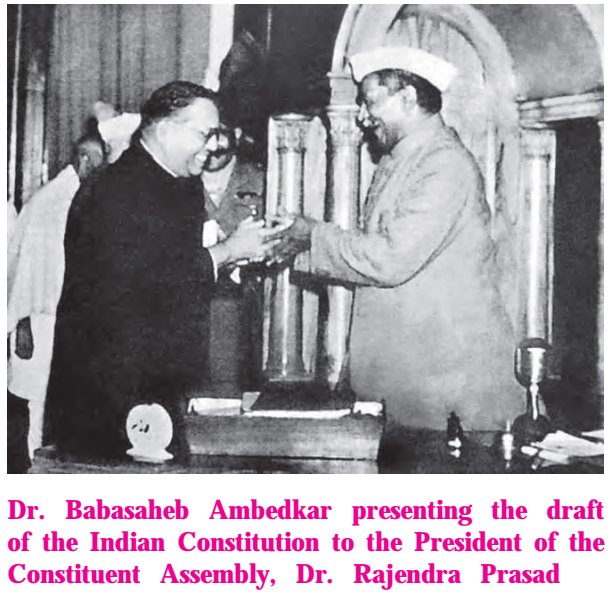
Dr. Babasaheb Ambedkar conducted a comparative study of the constitutions of various countries. Furthermore, after conducting an in-depth study of the reports submitted by all the committees of the Constituent Assembly, he prepared the draft and presented it before the Assembly.
Each provision within this draft was discussed in great detail. During these discussions, Dr. Babasaheb Ambedkar competently shouldered the responsibility
Simple Explanation
Dr. Babasaheb Ambedkar studied the constitutions of different countries and compared them. He also studied the reports submitted by all the committees of the Constituent Assembly in detail.
After studying these reports carefully, he prepared the draft of the Constitution and presented it before the Constituent Assembly.
Every provision in this draft was discussed in great detail. During these discussions, Dr. Babasaheb Ambedkar competently carried out the responsibility given to him.
Word Meanings
| English Word / Phrase | मराठी अर्थ | हिंदी अर्थ |
|---|---|---|
| Comparative study Study by comparing different things |
तुलनात्मक अभ्यास – वेगवेगळ्या गोष्टींची तुलना करून केलेला अभ्यास | तुलनात्मक अध्ययन – अलग-अलग चीजों की तुलना करके किया गया अध्ययन |
| Constitution The fundamental rules and principles for governing a country |
संविधान – देशाच्या शासनासाठीचे मूलभूत नियम व तत्त्वे | संविधान – देश के शासन के मूल नियम और सिद्धांत |
| In-depth study A very detailed study |
सखोल अभ्यास – एखाद्या विषयाचा अतिशय तपशीलवार अभ्यास | गहन अध्ययन – किसी विषय का बहुत विस्तृत अध्ययन |
| Reports Written accounts of work or findings |
अहवाल – काम किंवा निष्कर्षांची लेखी माहिती | रिपोर्ट – कार्य या निष्कर्षों की लिखित जानकारी |
| Draft A prepared version of a document before its final form |
मसुदा – अंतिम स्वरूपापूर्वी तयार केलेली दस्तऐवजाची आवृत्ती | प्रारूप – अंतिम रूप से पहले तैयार किया गया दस्तावेज़ |
| Provision A particular rule or part of a law |
तरतूद – कायद्यातील विशिष्ट नियम किंवा भाग | प्रावधान – कानून का कोई विशेष नियम या भाग |
| Discussed Talked about and considered carefully |
चर्चा केली – एखाद्या विषयावर विचारपूर्वक चर्चा केली | चर्चा की – किसी विषय पर विचारपूर्वक बातचीत की |
| Competently In a capable and proper manner |
कुशलतेने – योग्य आणि सक्षम पद्धतीने | कुशलतापूर्वक – योग्य और सक्षम तरीके से |
| Shouldered the responsibility Took responsibility and carried it out |
जबाबदारी स्वीकारून पार पाडली – जबाबदारी घेऊन ती पूर्ण केली | जिम्मेदारी संभाली – जिम्मेदारी लेकर उसे पूरा किया |