
The Constitution
of India
Independence Day and Republic Day
The questions and curiosity regarding the Indian Constitution that arose in Mary's mind are likely present in our minds as well. So, let us explore these topics through this chapter.
Samata begins by asking whether Independence Day and Republic Day are our national festivals. She wants to know about the importance of these two days.
Aman explains that Independence Day is celebrated on 15th August and Republic Day is celebrated on 26th January. He says that flag-hoisting ceremonies and other programmes are held at their school on both days. He also describes the atmosphere on these occasions as one of joy and enthusiasm.
Mary explains why Independence Day is celebrated on 15th August. India attained independence on 15th August 1947 and was liberated from British subjugation. Therefore, every year 15th August is celebrated as Independence Day.
Samata then asks what exactly Republic Day is. Her question leads the discussion towards the Constitution and the reason for celebrating Republic Day.
Aman explains that on 26th January 1950, the Constitution drafted by India to govern the country's administration came into force. Because the Constitution came into force on that day, 26th January is celebrated every year as Republic Day.
Mary now asks several questions. She wants to know why the day is called Republic Day, what exactly a Constitution is, who created it, why a Constitution is necessary, and why it was implemented specifically on 26th January 1950.
The textbook then connects Mary's questions with the curiosity that readers may also have about the Indian Constitution. It tells us that these questions will be explored through the chapter.
2.1 Meaning, Importance and Need of the Constitution
In the previous chapter, we studied the concept of ‘society’. Laws and rules are essential to ensure that the various components of a society coexist harmoniously and that everyone has equal opportunities for progress. To facilitate the functioning of society, almost every nation has created its own ‘Constitution’. The administration of our country, India, is conducted in accordance with our Constitution.
In the previous chapter, we studied the concept of society. A society has different components, and laws and rules are necessary so that these different components can live together harmoniously. These laws and rules also help ensure that everyone gets equal opportunities to progress. To make the functioning of society easier, almost every nation has created its own Constitution. In India also, the administration of the country is conducted in accordance with our Constitution.
| English Word / Phrase | मराठी अर्थ | हिंदी अर्थ |
|---|---|---|
| Society A group of people living together |
समाज – एकत्र राहणाऱ्या लोकांचा समूह | समाज – एक साथ रहने वाले लोगों का समूह |
| Essential Very necessary |
आवश्यक – खूप गरजेचे | आवश्यक – बहुत जरूरी |
| Components Different parts |
घटक – वेगवेगळे भाग | घटक – अलग-अलग भाग |
| Coexist Live together |
सहअस्तित्व असणे – एकत्र राहणे | साथ रहना – मिल-जुलकर रहना |
| Harmoniously Peacefully and with agreement |
सलोख्याने – शांततेने आणि एकोपा राखून | सौहार्दपूर्वक – शांति और मेल-जोल से |
| Equal opportunities Same chances for everyone |
समान संधी – प्रत्येकाला समान संधी | समान अवसर – सभी को समान मौके |
| Progress Development or improvement |
प्रगती – विकास किंवा सुधारणा | प्रगति – विकास या सुधार |
| Facilitate Make something easier |
सुलभ करणे – एखादी गोष्ट सोपी करणे | आसान बनाना – किसी काम को सरल करना |
| In accordance with According to |
नुसार – त्याप्रमाणे | के अनुसार – उसके मुताबिक |
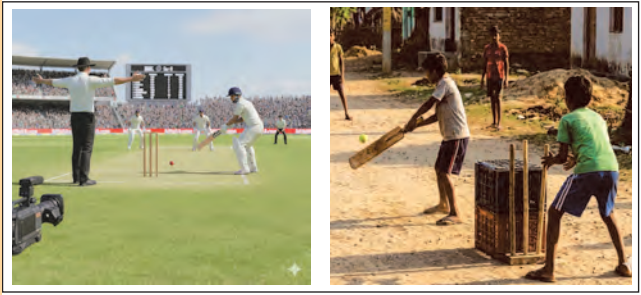
Based on the points listed below, explain the difference between a cricket match played on a sports ground and one played on the street; in doing so, explain importance of the following:
- Rules
- Boundaries
- Safety
- Umpires
1) Rules
Rules tell the players how the game should be played. On a sports ground, written rules are followed carefully, which makes the match organised and fair. In a street match, written rules may not be formally followed.
2) Boundaries
Boundaries help define the playing area and show where the ball can be considered inside or outside the field. On a sports ground, the playing area and its boundaries are clearly arranged. In street cricket, the playing area may be decided according to the available space.
3) Safety
Safety is important so that players and other people are protected while the game is being played. A sports ground provides an organised place for playing, whereas street cricket may be played in less organised surroundings.
4) Umpires
Umpires help conduct the match according to its rules and make decisions during the game. An organised cricket match has official umpires, while street matches may not have official umpires.
In a cricket match played on a sports ground, there is a sense of organization and formality and written rules are strictly observed. However, matches played on the street lack written rules, organization and official umpires. In the same vein, if a country is to be governed effectively, a Constitution is essential. Without a Constitution, the administration of the country cannot function smoothly.
SIMPLE EXPLANATION
The textbook first compares a cricket match played on a sports ground with a cricket match played on the street. In a match played on a sports ground, there is proper organisation and formality, and written rules are strictly followed. A street cricket match, on the other hand, does not have written rules, proper organisation or official umpires. The textbook then uses this comparison to explain the importance of a Constitution for a country. Just as proper rules and organisation are important for conducting a cricket match properly, a Constitution is essential for governing a country effectively. Without a Constitution, the administration of the country cannot function smoothly.
WORD MEANINGS
| English Word / Phrase | मराठी अर्थ | हिंदी अर्थ |
|---|---|---|
|
Sports ground A place where sports are played |
क्रीडांगण – खेळ खेळण्याची जागा | खेल का मैदान – खेल खेलने की जगह |
|
Organization Proper arrangement |
व्यवस्था – योग्य मांडणी किंवा व्यवस्था | व्यवस्था – उचित ढंग से की गई व्यवस्था |
|
Formality A proper established procedure |
औपचारिकता – ठरलेली योग्य पद्धत | औपचारिकता – तय की गई उचित प्रक्रिया |
|
Written rules Rules given in written form |
लिखित नियम – लिहिलेल्या स्वरूपातील नियम | लिखित नियम – लिखित रूप में दिए गए नियम |
|
Strictly observed Followed carefully |
काटेकोरपणे पाळले – काळजीपूर्वक पाळले | कड़ाई से पालन किया – ध्यानपूर्वक पालन किया |
|
Official umpires Authorised match officials |
अधिकृत पंच – अधिकृत सामनाधिकारी | आधिकारिक अंपायर – अधिकृत मैच अधिकारी |
|
Governed Managed or ruled |
शासित – कारभार चालवला जाणे | शासित – शासन किया जाना |
|
Effectively Properly and successfully |
प्रभावीपणे – योग्य प्रकारे आणि परिणामकारक रीतीने | प्रभावी रूप से – उचित और सफल तरीके से |
|
Essential Very necessary |
आवश्यक – अत्यंत गरजेचे | आवश्यक – बहुत जरूरी |
|
Function smoothly Work properly without difficulty |
सुरळीतपणे कार्य करणे – अडचणीशिवाय व्यवस्थित चालणे | सुचारू रूप से कार्य करना – बिना कठिनाई के ठीक से चलना |
What the comparison teaches
A cricket match needs proper organisation and rules to be conducted properly. In the same way, a country needs a Constitution for its administration to function smoothly.