
Meet Your New Coaching Class Manager
Manage Students, Attendance, Fees, Reports & WhatsApp — all in one powerful and easy-to-use app.
Our Social Life
📚 Topics in This Chapter
🌍 Chapter Introduction
📖 Textbook Paragraph
🌟 Simple Explanation
Human beings did not always live in the same way as we live today. Human life changed slowly over a very long period.
In the beginning, humans lived a nomadic life. This means that they moved from one place to another instead of living permanently in one place.
Over thousands of years, their social life gradually developed. They began to settle in places and live together in an organised society.
📚 Meanings
| Meanings | मराठी अर्थ | हिंदी अर्थ |
|---|---|---|
| Previously – at an earlier time | यापूर्वी – या आधी | पहले – इससे पहले |
| Evolution – slow development over time | उत्क्रांती – काळानुसार हळूहळू झालेला विकास | विकास-क्रम – समय के साथ धीरे-धीरे हुआ विकास |
| Social life – life lived with other people | सामाजिक जीवन – इतर लोकांसोबतचे जीवन | सामाजिक जीवन – दूसरे लोगों के साथ जीवन |
| Took shape – gradually developed | आकार घेतला – हळूहळू विकसित झाले | रूप लिया – धीरे-धीरे विकसित हुआ |
| Transitioned – changed from one condition to another | बदल झाला – एका अवस्थेतून दुसऱ्या अवस्थेत गेले | बदल गए – एक अवस्था से दूसरी अवस्था में गए |
| Nomadic existence – a life of moving from place to place | भटकंतीचे जीवन – एका ठिकाणाहून दुसरीकडे फिरत राहण्याचे जीवन | घुमंतू जीवन – एक स्थान से दूसरे स्थान पर घूमते रहने का जीवन |
| Settled – living permanently in one place | स्थिर – कायम एका ठिकाणी राहणारे | स्थायी – एक ही स्थान पर रहने वाला |
💡 Useful Information
- Nomadic life: People move from one place to another and do not have one permanent home.
- Settled social life: People live in one place and form lasting relationships with others.
- Social evolution: The gradual change in the way people live together.
🎯 Clear Concept
Human social life developed slowly. Humans moved from a wandering life to a settled life in society.1.1 Society: Meaning and Need
📖 Textbook Paragraph
🌟 Simple Explanation
Society does not mean only a group of people gathered in one place.
People living in society have many relationships with one another. These relationships connect them and form a social system.
Society includes everyone. It includes elderly people, adults, young people and small children. Every person is a part of society.
📚 Meanings
| Meanings | मराठी अर्थ | हिंदी अर्थ |
|---|---|---|
| Society – people connected through relationships | समाज – नातेसंबंधांनी जोडलेले लोक | समाज – संबंधों से जुड़े हुए लोग |
| Merely – only | केवळ – फक्त | केवल – सिर्फ |
| Collection – a group of people or things | समूह – लोकांचा किंवा वस्तूंचा गट | समूह – लोगों या वस्तुओं का दल |
| System – connected parts working together | व्यवस्था – एकत्र काम करणारे जोडलेले भाग | व्यवस्था – मिलकर काम करने वाले जुड़े भाग |
| Relationships – connections between people | नातेसंबंध – लोकांमधील संबंध | संबंध – लोगों के बीच का जुड़ाव |
| Individuals – separate persons | व्यक्ती – प्रत्येक स्वतंत्र माणूस | व्यक्ति – हर अलग इंसान |
| Encompasses – includes completely | समाविष्ट करते – सर्वांना सामावून घेते | शामिल करता है – सभी को अपने में रखता है |
| Elderly – old people | वृद्ध – वयस्कर लोक | बुजुर्ग – अधिक उम्र के लोग |
| Youth – young people | तरुण – युवा लोक | युवा – जवान लोग |
💡 Useful Information
A crowd and a society are not the same. A crowd may gather for a short time. A society is formed through continuing relationships among people.
🎯 Clear Concept
Society is a system of relationships among people. It includes people of every age.1.1.1 Why Did Humans Feel the Need for Society?
📖 Textbook Paragraph
🌟 Simple Explanation
During the nomadic stage, humans moved from place to place. Their lives were not stable, and they did not have enough security.
They understood that living together could help them meet their physical needs, such as food and shelter. It could also help them meet emotional needs, such as care, support and companionship.
When humans worked together, they could face difficult natural conditions more effectively. They also worked together to obtain food and build shelter.
Every person contributed some effort. The work became easier when it was shared by the whole group. This cooperation led to the beginning of human society.
📚 Meanings
| Meanings | मराठी अर्थ | हिंदी अर्थ |
|---|---|---|
| Nomadic stage – time when humans moved from place to place | भटकंतीची अवस्था – मानव एका ठिकाणाहून दुसरीकडे फिरत असलेला काळ | घुमंतू अवस्था – जब मानव एक स्थान से दूसरे स्थान पर घूमते थे |
| Stability – a steady and settled condition | स्थिरता – स्थायी आणि सुरक्षित अवस्था | स्थिरता – स्थायी और टिकाऊ अवस्था |
| Security – freedom from danger | सुरक्षितता – धोक्यापासून संरक्षण | सुरक्षा – खतरे से बचाव |
| Fulfil – meet or complete a need | पूर्ण करणे – गरज भागवणे | पूरा करना – आवश्यकता पूरी करना |
| Physical needs – needs of the body | शारीरिक गरजा – शरीराच्या गरजा | शारीरिक आवश्यकताएँ – शरीर की जरूरतें |
| Emotional needs – needs related to feelings | भावनिक गरजा – भावनांशी संबंधित गरजा | भावनात्मक आवश्यकताएँ – भावनाओं से जुड़ी जरूरतें |
| Collectively – by working together | एकत्रितपणे – सर्वांनी मिळून | सामूहिक रूप से – सबने मिलकर |
| Combat – face and fight against | सामना करणे – विरोधात लढणे | सामना करना – कठिनाई के विरुद्ध लड़ना |
| Adverse – difficult or harmful | प्रतिकूल – कठीण किंवा हानिकारक | प्रतिकूल – कठिन या हानिकारक |
| Procure – obtain or get | मिळवणे – प्राप्त करणे | प्राप्त करना – हासिल करना |
| Shelter – a safe place to live | निवारा – राहण्यासाठी सुरक्षित जागा | आश्रय – रहने के लिए सुरक्षित स्थान |
| Contributed – gave a share of work | योगदान दिले – कामात आपला वाटा दिला | योगदान दिया – काम में अपना हिस्सा दिया |
| Formation – the act of creating something | निर्मिती – तयार होण्याची प्रक्रिया | निर्माण – बनने की प्रक्रिया |
💡 Useful Information
- Physical needs: Basic needs of the body, such as food and shelter.
- Emotional needs: The need for care, support and understanding.
- Collective effort: Many people sharing work to achieve a common purpose.
🎯 Clear Concept
Humans formed society because cooperation gave them stability, security, food, shelter and emotional support.1.1.2 Human Sociability
📖 Textbook Paragraph
🌟 Simple Explanation
Human beings naturally like to live with other people. They enjoy being members of a community and spending time with one another.
People do not live in society only for safety or for satisfying physical and mental needs. Life in society also helps every part of their personality to develop.
When people are happy, they want to share their happiness. When they are sad, they want someone to understand their feelings.
People also like to share new ideas with family members and other loved ones. Sharing feelings and ideas helps their sociability develop.
📚 Meanings
| Meanings | मराठी अर्थ | हिंदी अर्थ |
|---|---|---|
| By nature – naturally | स्वभावतः – नैसर्गिकपणे | स्वभाव से – प्राकृतिक रूप से |
| Social beings – living beings who like being with others | सामाजिक प्राणी – इतरांसोबत राहणारे जीव | सामाजिक प्राणी – दूसरों के साथ रहने वाले जीव |
| Community – people living or connected together | समुदाय – एकत्र राहणारा किंवा जोडलेला लोकसमूह | समुदाय – साथ रहने वाला या जुड़ा हुआ जनसमूह |
| Company – being with other people | सहवास – इतर लोकांसोबत असणे | साथ – दूसरे लोगों के साथ रहना |
| Solely – only | केवळ – फक्त | केवल – सिर्फ |
| Mental needs – needs of the mind | मानसिक गरजा – मनाच्या गरजा | मानसिक आवश्यकताएँ – मन की जरूरतें |
| Holistic development – development of every part of a person | सर्वांगीण विकास – व्यक्तीच्या सर्व बाजूंचा विकास | सर्वांगीण विकास – व्यक्ति के हर पक्ष का विकास |
| Urge – a strong wish | तीव्र इच्छा – काही करण्याची खूप इच्छा | तीव्र इच्छा – कुछ करने की बहुत इच्छा |
| Sorrow – deep sadness | दुःख – खूप वाईट वाटण्याची भावना | दुःख – बहुत उदासी की भावना |
| Empathize – understand another person’s feelings | सहानुभूतीने समजून घेणे – दुसऱ्याच्या भावना समजणे | सहानुभूति रखना – दूसरे की भावनाएँ समझना |
| Occur – come into the mind | सुचणे – मनात येणे | सूझना – मन में आना |
| Loved ones – people whom we love | प्रियजन – आपल्याला प्रिय असलेले लोक | प्रियजन – वे लोग जिनसे हम प्रेम करते हैं |
| Emotional exchanges – sharing feelings | भावनिक देवाणघेवाण – भावना एकमेकांना सांगणे | भावनात्मक आदान-प्रदान – भावनाएँ एक-दूसरे से बाँटना |
| Intellectual exchanges – sharing thoughts and ideas | वैचारिक देवाणघेवाण – विचार आणि कल्पना एकमेकांना सांगणे | बौद्धिक आदान-प्रदान – विचार और कल्पनाएँ बाँटना |
| Sociability – ability to mix and interact with people | सामाजिकता – लोकांमध्ये मिसळण्याची आणि संवाद साधण्याची क्षमता | सामाजिकता – लोगों से मिलने-जुलने और बातचीत करने की क्षमता |
💡 Useful Information
- Holistic development: The development of a person’s body, mind, emotions and social abilities.
- Emotional exchange: Sharing happiness, sadness and other feelings.
- Intellectual exchange: Sharing ideas, knowledge and thoughts.
🎯 Clear Concept
Humans naturally need the company of others. Sharing feelings and ideas develops human sociability.🖼️ Textbook Activity
❓ Textbook Question
🌟 Simple Explanation of the Question
First, look carefully at the pictures showing society in the past, present and near future. Then think about the final picture and write what changes may take place in society twenty years from now.
📚 Meanings
| Meanings | मराठी अर्थ | हिंदी अर्थ |
|---|---|---|
| Observe – look at carefully | निरीक्षण करा – काळजीपूर्वक पाहा | ध्यान से देखिए – सावधानी से देखना |
| Posed – asked or presented | विचारलेला – समोर ठेवलेला प्रश्न | पूछा गया – सामने रखा गया प्रश्न |
| Final – last | अंतिम – शेवटचा | अंतिम – आखिरी |
🎯 What You Have to Do
Study the development of society shown in the first three pictures. Then give your own sensible idea about society after twenty years.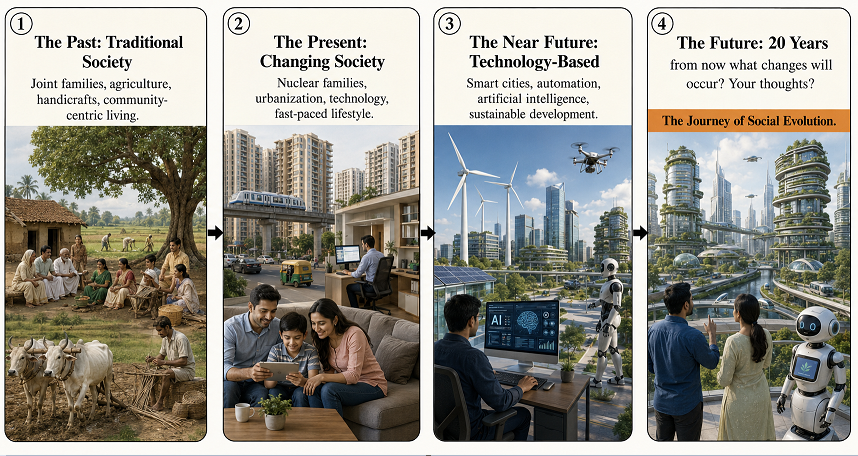
🔍 Understanding the Textbook Image
🖼️ Simple Explanation of the Image
The fourth picture asks students to imagine how society may change twenty years from now. The pictures show that society keeps changing with new ways of living and new technology.
📚 Meanings
| Meanings | मराठी अर्थ | हिंदी अर्थ |
|---|---|---|
| Traditional society – society following older ways of life | पारंपरिक समाज – जुन्या जीवनपद्धती पाळणारा समाज | पारंपरिक समाज – पुराने जीवन-तरीके अपनाने वाला समाज |
| Joint families – large families living together | संयुक्त कुटुंबे – अनेक सदस्य एकत्र राहणारी कुटुंबे | संयुक्त परिवार – अनेक सदस्यों वाला साथ रहने वाला परिवार |
| Agriculture – growing crops and farming | शेती – पिके उगवण्याचे काम | कृषि – फसल उगाने का काम |
| Handicrafts – useful or decorative things made by hand | हस्तकला – हाताने बनवलेल्या उपयोगी किंवा सजावटी वस्तू | हस्तशिल्प – हाथ से बनाई गई उपयोगी या सजावटी वस्तुएँ |
| Community-centric – mainly connected with the community | समुदाय-केंद्रित – समुदायाला महत्त्व देणारे | समुदाय-केंद्रित – समुदाय को मुख्य महत्त्व देने वाला |
| Nuclear families – parents and children living as a small family | विभक्त कुटुंबे – आई-वडील आणि मुले असलेले छोटे कुटुंब | एकल परिवार – माता-पिता और बच्चों वाला छोटा परिवार |
| Urbanisation – growth of towns and cities | शहरीकरण – शहरे आणि नगरांची वाढ | शहरीकरण – नगरों और शहरों का विकास |
| Fast-paced lifestyle – a very busy and quickly changing way of life | वेगवान जीवनशैली – अतिशय व्यस्त आणि वेगाने बदलणारी जीवनपद्धती | तेज जीवनशैली – बहुत व्यस्त और तेजी से बदलने वाला जीवन |
| Smart cities – cities using modern technology | स्मार्ट शहरे – आधुनिक तंत्रज्ञान वापरणारी शहरे | स्मार्ट शहर – आधुनिक तकनीक का उपयोग करने वाले शहर |
| Automation – machines doing work automatically | स्वयंचलन – यंत्रांनी आपोआप काम करणे | स्वचालन – मशीनों का अपने-आप काम करना |
| Artificial intelligence – technology that enables machines to perform intelligent tasks | कृत्रिम बुद्धिमत्ता – यंत्रांना बुद्धिमान कामे करण्यास मदत करणारे तंत्रज्ञान | कृत्रिम बुद्धिमत्ता – मशीनों को बुद्धिमान कार्य करने योग्य बनाने वाली तकनीक |
| Sustainable development – development that protects future needs | शाश्वत विकास – भविष्यातील गरजांचे रक्षण करणारा विकास | सतत विकास – भविष्य की जरूरतों की रक्षा करने वाला विकास |
💡 Useful Information
The image presents social change as a journey. It moves from traditional community life to present-day urban and technological life, and then towards a possible technology-based future.
🎯 Clear Concept
Society is not fixed. Family life, work, cities and technology change over time.✅ Suggested Answer
Twenty years from now, society may become more technology-based. Smart cities, automation and artificial intelligence may become more common. Machines may perform many routine tasks. Sustainable development may also receive greater importance. As a result, the ways people live, work and travel may change further.
Note: This is a suggested personal-response answer. Students may write their own sensible ideas based on the pictures.
🤝 Key Term: Sociability
📖 Textbook Paragraph
🌟 Simple Explanation
Sociability is a person’s natural ability to meet, communicate and live comfortably with other people.
A sociable person behaves peacefully with others and cooperates with them. Sociability helps people build good relationships and live together in society.
📚 Meanings
| Meanings | मराठी अर्थ | हिंदी अर्थ |
|---|---|---|
| Sociability – ability to interact well with others | सामाजिकता – इतरांशी चांगला संवाद साधण्याची क्षमता | सामाजिकता – दूसरों के साथ अच्छे से मिलने-जुलने की क्षमता |
| Capacity – ability to do something | क्षमता – एखादी गोष्ट करण्याची ताकद | क्षमता – कोई कार्य करने की योग्यता |
| Interact – communicate or act with others | संवाद साधणे – इतरांशी बोलणे किंवा व्यवहार करणे | बातचीत करना – दूसरों से बोलना या व्यवहार करना |
| Naturally – in a normal and easy manner | नैसर्गिकपणे – सहज आणि स्वाभाविक रीतीने | स्वाभाविक रूप से – सहज और प्राकृतिक तरीके से |
| Harmoniously – peacefully and without conflict | सामंजस्याने – शांतपणे आणि मतभेद न करता | मेल-जोल से – शांति और बिना झगड़े के |
| Cooperatively – by helping and working together | सहकार्याने – एकमेकांना मदत करून | सहयोग से – एक-दूसरे की सहायता करते हुए |
💡 Useful Information
Sociability is shown when people communicate naturally, respect one another, live peacefully and work together.