
Meet Your New Coaching Class Manager
Manage Students, Attendance, Fees, Reports & WhatsApp — all in one powerful and easy-to-use app.
Our Social Life
🖼️ Child Development through Sociability
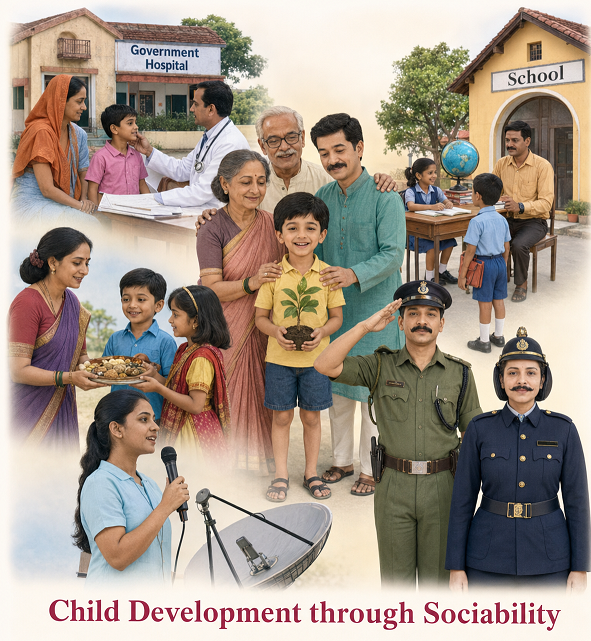
🔍 Explanation of the Image
🌟 Simple Explanation
The child is shown at the centre of the picture. Many people and institutions around the child help in the child’s development.
The family gives the child love, care and good values. The school provides education. The hospital and healthcare workers help protect the child’s health.
Police officers, soldiers and other members of society provide safety and support. The picture shows that a child develops through interaction and cooperation with family members, institutions and society.
📚 Meanings
| Meanings | मराठी अर्थ | हिंदी अर्थ |
|---|---|---|
| Child development – growth of a child in different areas | बालविकास – मुलाचा विविध बाजूंनी होणारा विकास | बाल विकास – बच्चे का अलग-अलग क्षेत्रों में विकास |
| Sociability – ability to interact well with others | सामाजिकता – इतरांशी चांगला संवाद साधण्याची क्षमता | सामाजिकता – दूसरों से अच्छे से मिलने-जुलने की क्षमता |
| Government hospital – a hospital operated by the government | सरकारी रुग्णालय – शासनाकडून चालवले जाणारे रुग्णालय | सरकारी अस्पताल – सरकार द्वारा चलाया जाने वाला अस्पताल |
| Education – the process of learning | शिक्षण – शिकण्याची प्रक्रिया | शिक्षा – सीखने की प्रक्रिया |
| Security – protection from danger | सुरक्षितता – धोक्यापासून संरक्षण | सुरक्षा – खतरे से बचाव |
| Community – people living and working together | समुदाय – एकत्र राहणारे आणि काम करणारे लोक | समुदाय – साथ रहने और काम करने वाले लोग |
💡 Useful Information
Children learn through their relationships with family members, teachers, friends and other people in society. Different institutions also help meet their needs.
🎯 Clear Concept
A child’s development takes place with the support of the family, school, healthcare services and society.1.1.3 Evolution of the Family Institution
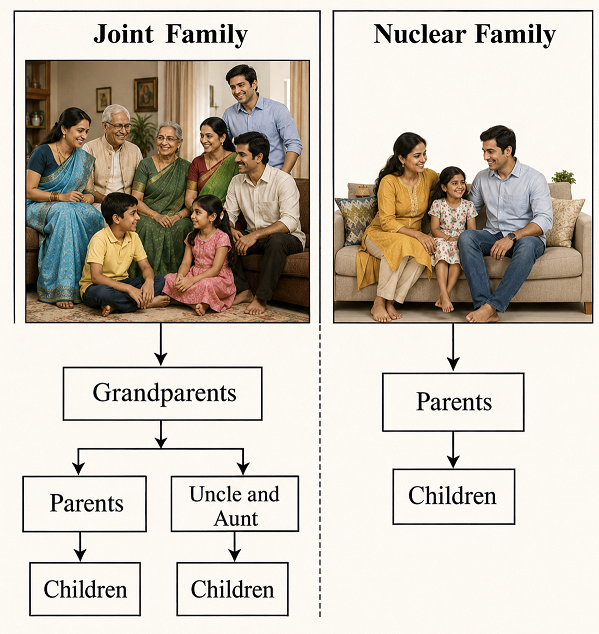
👨👩👧👦 Understanding the Family Diagram
🌟 Simple Explanation
The diagram shows two forms of family: a joint family and a nuclear family.
In the joint family diagram, grandparents, parents, uncles, aunts and children are connected as members of one large family.
In the nuclear family diagram, parents and their children form a smaller family.
📚 Meanings
| Meanings | मराठी अर्थ | हिंदी अर्थ |
|---|---|---|
| Joint family – a large family living together | संयुक्त कुटुंब – अनेक नातेवाईकांचे मोठे कुटुंब | संयुक्त परिवार – अनेक रिश्तेदारों वाला बड़ा परिवार |
| Nuclear family – parents and their children | विभक्त कुटुंब – आई-वडील आणि त्यांची मुले | एकल परिवार – माता-पिता और उनके बच्चे |
| Grandparents – parents of one’s mother or father | आजी-आजोबा – आई किंवा वडिलांचे आई-वडील | दादा-दादी या नाना-नानी – माता या पिता के माता-पिता |
| Parents – mother and father | आई-वडील – माता आणि पिता | माता-पिता – माँ और पिता |
| Uncle and aunt – brother or sister of a parent and their spouse | काका-मामा आणि काकू-मामी – आई-वडिलांचे भाऊ-बहीण व त्यांचे जोडीदार | चाचा-मामा और चाची-मामी – माता-पिता के भाई-बहन और उनके जीवनसाथी |
💡 Useful Information
The diagram explains family structure. The main difference shown is the number and relationship of family members included in each form.
🎯 Clear Concept
A nuclear family has parents and children, while a joint family includes other close relatives as well.1.1.3 Evolution of the Family Institution
📖 Textbook Paragraph
🌟 Simple Explanation
During the early period of human history, the idea of a family was not as clear as it is today. Humans lived a nomadic life and moved from place to place.
People gradually began living together because they needed protection from natural dangers. Living together gave them a feeling of security.
Humans started practising agriculture to fulfil their need for food. Agriculture helped them settle in one place and brought stability to their lives.
Farming required many people to work together. This need for a larger workforce helped the family system come into existence.
📚 Meanings
| Meanings | मराठी अर्थ | हिंदी अर्थ |
|---|---|---|
| Early stages – beginning period | प्रारंभिक अवस्था – सुरुवातीचा काळ | प्रारंभिक अवस्था – आरंभ का समय |
| Concept – an idea | संकल्पना – एखादी कल्पना | अवधारणा – कोई विचार |
| Defined – explained clearly | परिभाषित – स्पष्टपणे सांगितलेले | परिभाषित – स्पष्ट रूप से बताया गया |
| Nomadic life – life of moving from place to place | भटकंतीचे जीवन – एका ठिकाणाहून दुसरीकडे फिरण्याचे जीवन | घुमंतू जीवन – एक स्थान से दूसरे स्थान पर घूमने वाला जीवन |
| Seek – try to obtain | शोधणे – मिळवण्याचा प्रयत्न करणे | खोजना – प्राप्त करने का प्रयास करना |
| Natural hazards – dangers caused by nature | नैसर्गिक धोके – निसर्गामुळे निर्माण होणारे धोके | प्राकृतिक खतरे – प्रकृति से पैदा होने वाले खतरे |
| Emerged – appeared or developed | निर्माण झाली – दिसू किंवा विकसित होऊ लागली | उत्पन्न हुआ – दिखाई या विकसित होने लगा |
| Practising agriculture – doing farming | शेती करणे – पिके उगवण्याचे काम करणे | कृषि करना – फसल उगाने का कार्य करना |
| Stability – a settled condition | स्थिरता – स्थायी अवस्था | स्थिरता – स्थायी अवस्था |
| Significant workforce – a large number of workers | मोठे मनुष्यबळ – कामासाठी आवश्यक असलेले अनेक लोक | बड़ा कार्यबल – काम के लिए आवश्यक अनेक लोग |
| Came into existence – began to exist | अस्तित्वात आले – निर्माण झाले | अस्तित्व में आया – बनना शुरू हुआ |
💡 Useful Information
- Agriculture: Growing crops required people to remain near their fields.
- Workforce: The people available to perform work.
- Family institution: An organised family system in which members live together and care for one another.
🎯 Clear Concept
The need for safety, settled farming and shared work helped the family institution develop.✏️ Let’s Do It.
❓ Textbook Question
🌟 Simple Explanation of the Question
Prepare a chart showing the different members of your family and the household work performed by each person.
After that, make a separate list of the household tasks that you personally perform.
📚 Meanings
| Meanings | मराठी अर्थ | हिंदी अर्थ |
|---|---|---|
| Chart – information arranged clearly | तक्ता – माहितीची स्पष्ट मांडणी | चार्ट – जानकारी की स्पष्ट व्यवस्था |
| Depicting – showing | दर्शविणे – दाखवणे | दर्शाना – दिखाना |
| Division of labour – sharing different tasks among people | श्रमविभाजन – वेगवेगळी कामे लोकांमध्ये वाटणे | श्रम-विभाजन – अलग-अलग काम लोगों में बाँटना |
| Household – connected with the home | घरगुती – घराशी संबंधित | घरेलू – घर से संबंधित |
| Chores – regular small tasks | दैनंदिन कामे – नियमितपणे केली जाणारी छोटी कामे | रोजमर्रा के काम – नियमित किए जाने वाले छोटे काम |
| Personally – by yourself | स्वतः – आपल्या हाताने | स्वयं – अपने-आप |
| Perform – do a task | करणे – एखादे काम पूर्ण करणे | करना – कोई कार्य पूरा करना |
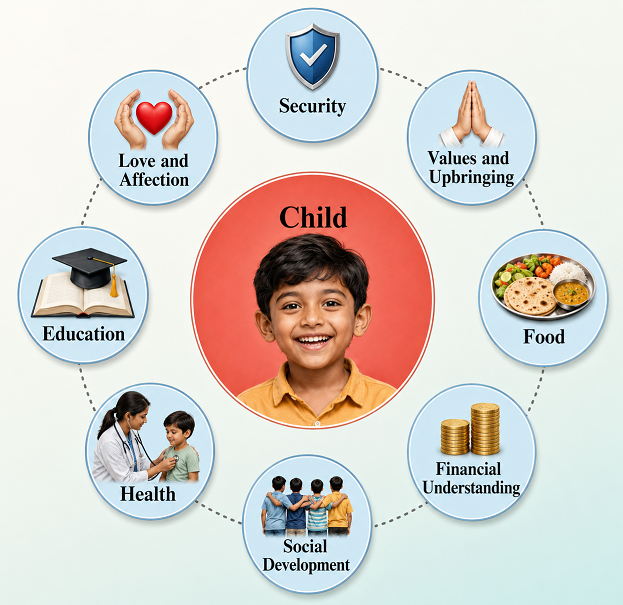
🔍 Understanding the Child Development Chart
🌟 Simple Explanation
The child is placed at the centre of the chart. The surrounding circles show important things needed for the child’s proper development.
These include love and affection, security, values and upbringing, food, financial understanding, social development, health and education.
All these needs work together to support the child’s complete development.
📚 Meanings
| Meanings | मराठी अर्थ | हिंदी अर्थ |
|---|---|---|
| Affection – a feeling of love and care | माया – प्रेम आणि काळजीची भावना | स्नेह – प्रेम और देखभाल की भावना |
| Upbringing – the way a child is raised | संगोपन – मुलाचे पालनपोषण करण्याची पद्धत | पालन-पोषण – बच्चे को बड़ा करने का तरीका |
| Values – good principles that guide behaviour | मूल्ये – वर्तनाला योग्य दिशा देणारी चांगली तत्त्वे | मूल्य – व्यवहार को सही दिशा देने वाले अच्छे सिद्धांत |
| Financial understanding – basic knowledge about money | आर्थिक समज – पैशांविषयी प्राथमिक माहिती | आर्थिक समझ – पैसे के बारे में सामान्य जानकारी |
| Social development – learning to interact with others | सामाजिक विकास – इतरांशी वागणे आणि संवाद साधणे शिकणे | सामाजिक विकास – दूसरों से व्यवहार और बातचीत करना सीखना |
💡 Useful Information
Child development is not limited to physical growth. Emotional care, learning, health, security, social interaction and good values are also important.
🎯 Clear Concept
A child needs care, safety, food, health, education, values and social support for complete development.✅ Suggested Solution — Let’s Do It.
Sample Family Division-of-Labour Chart
This is only a sample. Students should change the members and tasks according to their own families.
| Family Member | Examples of Household Work |
|---|---|
| Parents or guardians | Planning household work, preparing meals, shopping and managing family needs |
| Grandparents or elderly members | Giving guidance, helping with suitable tasks and caring for younger members |
| Children | Arranging books, keeping their room tidy, watering plants and helping during meals |
| All family members | Keeping the home clean and helping one another when required |
Household Chores I Personally Perform
- I arrange my books and school materials.
- I keep my room and study area tidy.
- I make my bed.
- I water the plants.
- I help set the table before meals.
- I put my clothes and belongings in their proper places.
- I help family members whenever suitable help is needed.
1.1.4 Division of Labour in Society
📖 Textbook Paragraph
🌟 Simple Explanation
Society contains different groups. These groups may have different customs and traditions. Rules and laws are formed while considering this diversity.
One person cannot perform every task needed by the whole group. Therefore, different tasks are divided among different people.
This sharing of work is called the division of labour. Division of labour played an important role in the formation of society.
Rules were later established so that people could interact and perform their work smoothly.
📚 Meanings
| Meanings | मराठी अर्थ | हिंदी अर्थ |
|---|---|---|
| In accordance with – according to | त्यानुसार – एखाद्या गोष्टीप्रमाणे | के अनुसार – किसी बात के मुताबिक |
| Diverse – of many different kinds | विविध – अनेक वेगवेगळ्या प्रकारचे | विविध – कई अलग-अलग प्रकार के |
| Customs – accepted traditional practices | रूढी – परंपरेने चालत आलेल्या पद्धती | रीति-रिवाज – परंपरा से चली आ रही प्रथाएँ |
| Traditions – beliefs and practices passed through generations | परंपरा – पिढ्यान्पिढ्या चालत आलेल्या पद्धती | परंपराएँ – पीढ़ियों से चली आ रही मान्यताएँ और प्रथाएँ |
| Constituent groups – groups that form a larger society | घटक समूह – मोठा समाज तयार करणारे गट | घटक समूह – बड़े समाज को बनाने वाले समूह |
| Feasible – possible to do | शक्य – करता येण्यासारखे | संभव – जो किया जा सके |
| Consequently – as a result | परिणामी – त्याचा परिणाम म्हणून | परिणामस्वरूप – उसके परिणाम के रूप में |
| Division of labour – sharing tasks among different people | श्रमविभाजन – कामे वेगवेगळ्या लोकांमध्ये वाटणे | श्रम-विभाजन – काम अलग-अलग लोगों में बाँटना |
| Subsequently – later | त्यानंतर – नंतरच्या काळात | बाद में – उसके पश्चात |
| Ensure – make certain | खात्री करणे – निश्चित करणे | सुनिश्चित करना – पक्का करना |
| Smooth functioning – working properly without difficulty | सुरळीत कार्य – अडचणीशिवाय योग्य प्रकारे चालणारे काम | सुचारु संचालन – बिना कठिनाई के ठीक तरह से चलना |
| Social interactions – communication and dealings among people | सामाजिक परस्परसंवाद – लोकांमधील संवाद आणि व्यवहार | सामाजिक संपर्क – लोगों के बीच बातचीत और व्यवहार |
💡 Useful Information
Division of labour means assigning different tasks to different people. It prevents one person from having to perform every task and helps work proceed smoothly.
🎯 Clear Concept
Society functions smoothly when work is divided and people follow commonly accepted rules and laws.📗 Key Definition: Family
📖 Textbook Paragraph
🌟 Simple Explanation
A family is a group of people who live as one unit and care for one another. Family members may be connected by birth, marriage or adoption.
📚 Meanings
| Meanings | मराठी अर्थ | हिंदी अर्थ |
|---|---|---|
| Collective unit – people living and working together as one group | सामूहिक घटक – एक गट म्हणून एकत्र राहणारे लोक | सामूहिक इकाई – एक समूह की तरह साथ रहने वाले लोग |
| Ties of blood – relationships through birth | रक्ताचे नाते – जन्मामुळे निर्माण झालेले नाते | खून का रिश्ता – जन्म से बना संबंध |
| Marriage – a recognised union of two people | विवाह – दोन व्यक्तींचे मान्य नाते | विवाह – दो व्यक्तियों का मान्य संबंध |
| Adoption – legally accepting a child into a family | दत्तक – मुलाला कायदेशीरपणे कुटुंबात स्वीकारणे | गोद लेना – बच्चे को कानूनी रूप से परिवार में स्वीकार करना |
💡 Useful Information
Care and responsibility for one another are important features of a family.
🎯 Clear Concept
A family is a caring social unit connected through birth, marriage or adoption.🏠 Key Definition: Small or Nuclear Family
📖 Textbook Paragraph
🌟 Simple Explanation
A small or nuclear family normally has four or fewer members. It may include the mother, father and their children.
📚 Meanings
| Meanings | मराठी अर्थ | हिंदी अर्थ |
|---|---|---|
| Nuclear family – a small family of parents and children | विभक्त कुटुंब – आई-वडील आणि मुलांचे छोटे कुटुंब | एकल परिवार – माता-पिता और बच्चों का छोटा परिवार |
| Members – people belonging to a group | सदस्य – गटातील व्यक्ती | सदस्य – समूह में शामिल व्यक्ति |
| Considered – regarded or thought of as | मानले जाते – असे समजले जाते | माना जाता है – ऐसा समझा जाता है |
💡 Useful Information
The textbook identifies a family with four or fewer members as a small or nuclear family.
🎯 Clear Concept
A nuclear family is a small family mainly consisting of parents and their children.🏡 Key Definition: Large or Joint Family
📖 Textbook Paragraph
🌟 Simple Explanation
A large or joint family includes parents and children along with other relatives. These may include grandparents, uncles, aunts and their children.
📚 Meanings
| Meanings | मराठी अर्थ | हिंदी अर्थ |
|---|---|---|
| Large family – a family containing many members | मोठे कुटुंब – अनेक सदस्य असलेले कुटुंब | बड़ा परिवार – अनेक सदस्यों वाला परिवार |
| Joint family – close relatives living as one family | संयुक्त कुटुंब – जवळचे नातेवाईक एक कुटुंब म्हणून राहतात | संयुक्त परिवार – करीबी रिश्तेदार एक परिवार के रूप में रहते हैं |
| Alongside – together with | सोबत – एकत्र | के साथ – एक साथ |
| Referred to as – called by a particular name | असे म्हटले जाते – या नावाने ओळखले जाते | कहा जाता है – इस नाम से जाना जाता है |
💡 Useful Information
A joint family connects more than one generation and includes close relatives beyond only parents and children.