
Harappan Civilisation
Chapter 3 · Maharashtra Board · Textbook Page 17
Time span of Harappan Civilisation
Imagine that we are entering into distant past, thousands of years ago. The history of the Harappan Civilisation is not only about a time period but it represents the journey of human civilisation. During this period, various events unfolded. Social and cultural transformations took place. The Harappan civilisation flourished in stages. On course of time it faced various calamities and the civilisation gradually declined. In essence, the timeline of this civilisation was marked by a progression, indicating stages from emergence, process to decline.
Simple Explanation
We are asked to imagine going back into the distant past, thousands of years ago, when the Harappan Civilisation existed.
The history of the Harappan Civilisation is not simply about how many years it existed. It also tells us about the journey and development of human civilisation during that time.
During this long period, many different events happened. These events brought changes to the lives of people.
There were also social and cultural transformations. This means that the way people lived in society and their culture changed over time.
The Harappan Civilisation did not develop all at once. It flourished in different stages.
As time passed, the civilisation faced various calamities. Because of these changes and difficulties, the civilisation gradually declined.
In simple words, the timeline of the Harappan Civilisation shows a clear progression. It moved through different stages, beginning with its emergence, continuing through its development and finally reaching its decline.
| Meanings | Marathi Arth | Hindi Arth |
|---|---|---|
| Distant past — a very long time ago | दूरचा भूतकाळ | दूर का अतीत |
| Journey — a process of moving or developing through time | प्रवास | यात्रा / सफर |
| Events — things that happen | घटना | घटनाएँ |
| Unfolded — happened or developed gradually | घडत गेले / उलगडले | घटित हुए / धीरे-धीरे सामने आए |
| Social — related to society and people | सामाजिक | सामाजिक |
| Cultural — related to culture and way of life | सांस्कृतिक | सांस्कृतिक |
| Transformations — major changes | परिवर्तन | परिवर्तन |
| Flourished — developed and prospered | भरभराट झाली / विकसित झाली | फली-फूली / विकसित हुई |
| Calamities — serious natural or difficult events | आपत्ती | आपदाएँ |
| Declined — gradually became weaker | ऱ्हास झाला / घट झाली | पतन हुआ / कम हुआ |
| Progression — movement through stages | प्रगती / क्रमाने होणारी वाटचाल | प्रगति / क्रमिक विकास |
| Emergence — beginning or coming into existence | उदय / अस्तित्वात येणे | उद्भव / अस्तित्व में आना |
Let us explore the three successive phases of the Harappan Civilisation.
Simple Explanation
The Harappan Civilisation developed through three successive phases.
The word successive means that these phases came one after another in a particular order.
The textbook now asks us to study these three phases and understand how the Harappan Civilisation developed over time.
| Meanings | Marathi Arth | Hindi Arth |
|---|---|---|
| Explore — study or examine carefully | अभ्यास करणे / शोध घेणे | अध्ययन करना / खोज करना |
| Successive — following one after another | क्रमिक / एकापाठोपाठ एक | क्रमिक / एक के बाद एक |
| Phases — stages or periods of development | टप्पे / अवस्था | चरण / अवस्थाएँ |
These successive phases are classified as follows :
Simple Explanation
The three phases of the Harappan Civilisation are arranged and classified according to their different periods of development.
The three phases are the Early Harappan Period, the Mature Harappan Period and the Late Harappan Period.
| Meanings | Marathi Arth | Hindi Arth |
|---|---|---|
| Classified — arranged into groups or categories | वर्गीकृत | वर्गीकृत |
| Phases — stages or periods | टप्पे / अवस्था | चरण / अवस्थाएँ |
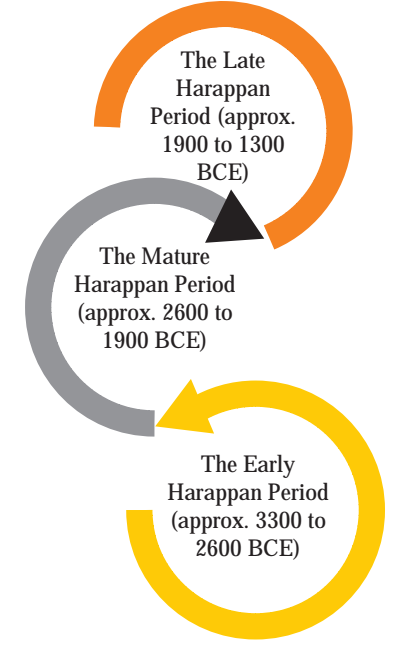
Early Harappan Period
Approx. 3300 to 2600 BCE
Mature Harappan Period
Approx. 2600 to 1900 BCE
Late Harappan Period
Approx. 1900 to 1300 BCE
Village settlements of Harappan Civilisation - The initial phase of village settlements within the Harappan Civilisation is known as the Early Harappan Period (approx. 3300 to 2600 BCE). During this period, a gradual transition from villages to cities took place, marking the beginning of the process of ‘urbanisation’.
Simple Explanation
The first phase of the Harappan Civilisation is called the Early Harappan Period.
This was the initial phase of the village settlements of the Harappan Civilisation.
The Early Harappan Period lasted approximately from 3300 to 2600 BCE.
During this period, villages gradually started changing and developing into cities.
This gradual change from villages to cities marked the beginning of the process called urbanisation.
| Meanings | Marathi Arth | Hindi Arth |
|---|---|---|
| Initial — first or beginning | प्रारंभिक | प्रारंभिक |
| Phase — a stage or period | टप्पा / अवस्था | चरण / अवस्था |
| Settlement — a place where people live | वस्ती / वसाहत | बस्ती / बसावट |
| Transition — gradual change from one state to another | संक्रमण / बदल | संक्रमण / बदलाव |
| Gradual — happening slowly step by step | हळूहळू | धीरे-धीरे |
| Urbanisation — development of towns and cities | नागरीकरण | नगरीकरण |
The flourishing Mature Harappan Civilisation - The Mature Harappan Period (approx. 2600 to 1900 BCE) is considered as the most flourishing period of the Harappan Civilisation. During this time, significant developments occurred in urban planning, administration, trade and handicrafts and sculpture. Major centers of the civilisation such as Mohenjodaro, Harappa, Dholavira and Lothal flourished during this period.
Simple Explanation
The second phase is called the Mature Harappan Period.
It lasted approximately from 2600 to 1900 BCE.
This period is considered the most flourishing period of the Harappan Civilisation. In other words, the civilisation was highly developed and successful during this period.
Important developments took place in urban planning. This means that the planning and organisation of cities developed significantly.
Developments also took place in administration, trade, handicrafts and sculpture.
Several major centres of the civilisation flourished during this period. These included Mohenjodaro, Harappa, Dholavira and Lothal.
| Meanings | Marathi Arth | Hindi Arth |
|---|---|---|
| Flourishing — developing and prospering greatly | भरभराट होत असलेले | फलता-फूलता / समृद्ध |
| Significant — important or considerable | महत्त्वपूर्ण | महत्त्वपूर्ण |
| Urban planning — planned development of cities | नगररचना / नागरी नियोजन | नगर नियोजन |
| Administration — management of a system or area | प्रशासन | प्रशासन |
| Trade — buying, selling or exchanging goods | व्यापार | व्यापार |
| Handicrafts — objects made by hand | हस्तकला | हस्तशिल्प |
| Sculpture — art of making figures or objects | शिल्पकला | मूर्तिकला |
| Major — very important or large | प्रमुख | प्रमुख |
| Centres — important places or locations | केंद्रे | केंद्र |
The Period of Decline of the Harappan Civilisation - The Late Harappan Period (approx. 1900 to 1300 BCE) marks the phase when the Harappan Civilisation gradually began to decline. Its major centers were destroyed or abandoned. The remnants of this phase found at some sites provide insights into the cultural changes.
Simple Explanation
The third phase is called the Late Harappan Period.
This period lasted approximately from 1900 to 1300 BCE.
During this phase, the Harappan Civilisation gradually began to decline.
Some of its major centres were destroyed or abandoned. Abandoned means that people left those places and stopped living there.
Some remains from this phase have been found at different sites.
These remains help us understand the cultural changes that took place during this period.
| Meanings | Marathi Arth | Hindi Arth |
|---|---|---|
| Decline — gradual weakening or decrease | ऱ्हास / अधोगती | पतन / गिरावट |
| Destroyed — completely damaged | नष्ट झालेले | नष्ट / बर्बाद |
| Abandoned — left empty or left by people | ओसाड सोडलेले / त्यागलेले | छोड़ा हुआ / परित्यक्त |
| Remnants — remaining parts or remains | अवशेष | अवशेष |
| Insights — clear understanding of something | अंतर्दृष्टी / सखोल माहिती | अंतर्दृष्टि / गहरी समझ |
| Cultural changes — changes in the culture and way of life | सांस्कृतिक बदल | सांस्कृतिक परिवर्तन |
This is a map-based activity. Locate each of the six Harappan sites on the map and note their present-day regions.
3.2 Location and Extent
A large number of settlements of the Harappan Civilisation were found in Indus basin. The fertile soil in this region provided a significant boost to agriculture. Thus, Harappan settlements were established along the riverbanks.
Simple Explanation
A large number of settlements belonging to the Harappan Civilisation were found in the Indus basin.
The soil in this region was fertile. Fertile soil is useful for growing crops.
Because the fertile soil helped agriculture, it gave a significant boost to farming.
Therefore, Harappan settlements were established along the riverbanks.
| Meanings | Marathi Arth | Hindi Arth |
|---|---|---|
| Settlements — places where people live | वस्त्या / वसाहती | बस्तियाँ / बसावट |
| Basin — a low area drained by a river and its branches | खोरे | नदी बेसिन / नदी का जलग्रहण क्षेत्र |
| Fertile — able to produce good crops | सुपीक | उपजाऊ |
| Significant — important or considerable | महत्त्वपूर्ण | महत्त्वपूर्ण |
| Agriculture — farming and cultivation of crops | शेती / कृषी | कृषि / खेती |
| Riverbanks — land along the sides of a river | नदीकाठ | नदी के किनारे |