Harappan Civilisation
Chapter 3 · Maharashtra Board · Textbook Page 19
Lifestyle and Construction of houses
The houses of Harappan people were mainly built by using baked bricks.
Simple Explanation
The people of the Harappan Civilisation mainly constructed their houses using baked bricks.
This means that bricks were an important material used for building their houses.
| Meanings | Marathi Arth | Hindi Arth |
|---|---|---|
| Mainly — mostly | मुख्यतः | मुख्य रूप से |
| Built — constructed or made | बांधलेले | बनाए गए / निर्मित |
| Baked bricks — bricks hardened by heating | भाजलेल्या विटा | पकी हुई ईंटें |
The method employed by the people of the Harappan Civilisation for constructing houses is generally known as the ‘English Bond’ masonry. In this method, while building a wall, two headers and two stretchers were used alternatively. It made the walls exceptionally strong and durable. The bricks used were of standardized proportion. A typical brick used to have a ratio of 1:2:4. Harappan people adopted this method to ensure the safety of their homes from floods, earthquakes and the gradual wear and tear caused by the passage of time.
Simple Explanation
The Harappan people used a method of building houses that is generally called ‘English Bond’ masonry.
In this method of building a wall, two headers and two stretchers were used alternately.
This method made the walls very strong and durable. Durable means that the walls could remain strong for a long time.
The bricks were made in a standardized proportion. A typical brick had a ratio of 1:2:4.
The Harappan people used this construction method to make their homes safer from floods, earthquakes and gradual wear and tear.
Wear and tear means the gradual damage or weakening that can happen as something is used and as time passes.
| Meanings | Marathi Arth | Hindi Arth |
|---|---|---|
| Masonry — building with bricks or other materials | बांधकाम | चिनाई / राजगीरी |
| Headers — bricks placed with their shorter end showing on the wall face | हेडर विटा | हेडर ईंटें |
| Stretchers — bricks placed with their longer side showing on the wall face | स्ट्रेचर विटा | स्ट्रेचर ईंटें |
| Alternatively — one after another in turn | आलटून पालटून | बारी-बारी से |
| Exceptionally — unusually or extremely | असामान्यपणे / अत्यंत | असाधारण रूप से |
| Strong — able to withstand force | मजबूत | मजबूत |
| Durable — able to last for a long time | टिकाऊ | टिकाऊ |
| Standardized — made according to a fixed standard | प्रमाणित / ठरावीक मापाचे | मानकीकृत |
| Proportion — relationship between sizes or quantities | प्रमाण | अनुपात |
| Ensure — make sure | खात्री करणे | सुनिश्चित करना |
| Wear and tear — gradual damage caused by use and time | झीज व झीजेमुळे होणारे नुकसान | घिसावट और टूट-फूट |
The houses featured a central courtyard surrounded by rooms, along with a well and a toilet situated near the entrance. The systems for water supply and waste water disposal were exceptionally efficient. Baked earthen conduits were utilized to drain waste water out of every house. Noteworthy feature was that the street drains were constructed using bricks and were kept properly covered. This demonstrates their high degree of awareness they possessed regarding public health.
Simple Explanation
Harappan houses had a central courtyard. Rooms were built around this courtyard.
The houses also had a well and a toilet near the entrance.
Their systems for getting water and removing wastewater were very efficient.
They used baked earthen conduits to carry wastewater away from every house. Conduits are channels or pipes used to carry water.
Another important feature was that the street drains were made using bricks.
These street drains were also properly covered.
All these arrangements show that the Harappan people had a high level of awareness about public health.
| Meanings | Marathi Arth | Hindi Arth |
|---|---|---|
| Central courtyard — open space in the middle of a house | मध्यवर्ती अंगण | मध्य आँगन |
| Surrounded — having something all around it | वेढलेले | घिरा हुआ |
| Situated — located or placed | स्थित | स्थित |
| Waste water — used or dirty water | सांडपाणी | गंदा पानी / अपशिष्ट जल |
| Disposal — removal of something unwanted | विल्हेवाट | निपटान |
| Efficient — working well and properly | कार्यक्षम | कुशल / प्रभावी |
| Conduits — channels or pipes for carrying water | वाहिन्या | नलिकाएँ / वाहिनियाँ |
| Drain — carry away water or waste | निचरा करणे | जल निकासी करना |
| Noteworthy — worthy of attention | लक्षवेधी / उल्लेखनीय | उल्लेखनीय |
| Awareness — knowledge or understanding of something | जागरूकता | जागरूकता |
| Public health — health of people in a community | सार्वजनिक आरोग्य | सार्वजनिक स्वास्थ्य |
Beginning with the Harappan civilisation to the ‘Swachh Bharat Abhiyan’, it becomes evident that cleanliness is a fundamental necessity.
Describe how cleanliness is maintained in your village or city.
The streets in Harappan cities were broad and laid out in a grid pattern. Houses were built in the rectangular blocks created by them. The cities were generally divided into two or more sections. Each section had a separate fortification wall. The section at north-west was constructed on elevated ground, which is called as ‘Citadel’. It is likely that administrators resided in Citadel. The section at the south of Citadel was occupied by common residents.
Simple Explanation
The streets in Harappan cities were broad and were arranged in a grid pattern. A grid pattern means that the streets were laid out in an organised arrangement.
Houses were built inside the rectangular blocks formed by these streets.
The cities were generally divided into two or more sections.
Each section had its own fortification wall.
The section in the north-west was built on elevated ground. This section was called the Citadel.
The textbook says that it is likely that administrators lived in the Citadel.
The section to the south of the Citadel was occupied by common residents.
| Meanings | Marathi Arth | Hindi Arth |
|---|---|---|
| Broad — wide | रुंद | चौड़ा |
| Grid pattern — an organised arrangement of crossing streets | जाळीच्या नमुन्यातील रचना | जालीनुमा व्यवस्था |
| Rectangular — having four sides with opposite sides equal | आयताकृती | आयताकार |
| Section — a separate part of something | भाग / विभाग | भाग / खंड |
| Fortification — defensive wall or structure | तटबंदी | किलेबंदी |
| Elevated — raised or higher than the surrounding land | उंचावलेले | ऊँचा / ऊँचाई पर स्थित |
| Citadel — a strongly protected elevated part of a city | दुर्ग / उंचावरील संरक्षित भाग | दुर्ग / किले का सुरक्षित ऊँचा भाग |
| Administrators — people who manage or govern | प्रशासक | प्रशासक |
| Resided — lived in a place | राहत होते | निवास करते थे |
| Common residents — ordinary people living in an area | सामान्य रहिवासी | सामान्य निवासी |
A Citadel refers to the innermost and most secure part of a fort, often considered the very heart of the fortress. It is typically constructed at the highest elevation within the fort complex. This strategic positioning facilitates easy surveillance of the surrounding landscape and serves as the final line of defense during an enemy attack. The Citadel has key structures such as the royal palace, the royal court, the armory, store house of grains and temples. The Citadel held a position of immense importance in forts, such as Raigad and Rajgad. Try drawing a sketch of one such Citadel on a blackboard or in your notebook.
Simple Explanation
A Citadel is the innermost and safest part of a fort. It is often considered the most important central part of the fortress.
It is usually built at the highest level inside the fort.
Because it is placed at a high position, it becomes easier to watch the surrounding area.
The Citadel also acts as the final line of defence when an enemy attacks.
A Citadel can have important structures such as a royal palace, royal court, armory, storehouse of grains and temples.
The textbook gives Raigad and Rajgad as examples of forts where the Citadel had great importance.
The activity asks students to draw a sketch of a Citadel on the blackboard or in their notebook.
| Meanings | Marathi Arth | Hindi Arth |
|---|---|---|
| Innermost — furthest inside | सर्वांत आतील | सबसे अंदरूनी |
| Secure — safe and protected | सुरक्षित | सुरक्षित |
| Fortress — a strongly protected fort | किल्ला / दुर्ग | किला / दुर्ग |
| Elevation — height of a place above surrounding land | उंची | ऊँचाई |
| Strategic — carefully planned for an important purpose | धोरणात्मक | रणनीतिक |
| Surveillance — careful watching | निगराणी | निगरानी |
| Landscape — the visible area of land around a place | भूदृश्य / परिसर | भूदृश्य / आसपास का क्षेत्र |
| Defence — protection from attack | संरक्षण / बचाव | रक्षा / बचाव |
| Armory — place where weapons are kept | शस्त्रागार | शस्त्रागार |
| Storehouse — building where things are stored | कोठार / साठवणगृह | भंडारगृह |
| Immense — extremely large or great | प्रचंड / अफाट | विशाल / बहुत अधिक |
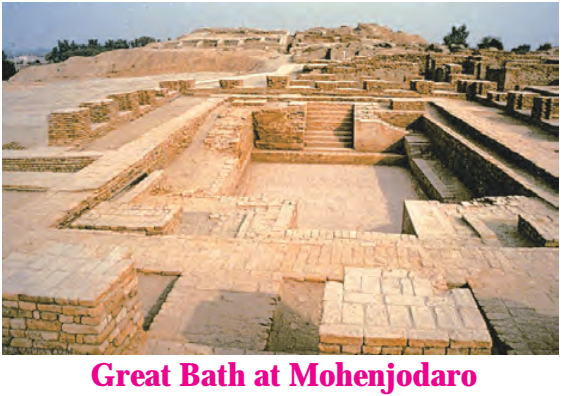
The Great Bath at Mohenjodaro is an unique example of the Harappan architecture. Some scholars are of the opinion that some religious rituals were
Simple Explanation
The Great Bath at Mohenjodaro is described as a unique example of Harappan architecture.
The textbook then says that some scholars believe that some religious rituals were connected with the Great Bath.
The sentence continues beyond the visible portion of this page, so its remaining meaning will be explained when the continuation appears on the next textbook page.
| Meanings | Marathi Arth | Hindi Arth |
|---|---|---|
| Unique — one of its kind; special | अद्वितीय / वैशिष्ट्यपूर्ण | अद्वितीय / अनोखा |
| Architecture — art and method of designing and building structures | वास्तुकला | वास्तुकला |
| Scholars — learned people who study a subject deeply | विद्वान | विद्वान |
| Religious — related to religion | धार्मिक | धार्मिक |
| Rituals — actions performed according to religious or traditional practices | धार्मिक विधी / विधी | धार्मिक अनुष्ठान / विधियाँ |