
GRADE 6 • HISTORY • SSC MAHARASHTRA STATE BOARD
Chapter 2: Prehistoric Period
Page 9 — Easy Page-wise Explanation
🌍 2.1 Ancient India – Geographical Background
📜 Textbook Paragraph
🌟 Simple Explanation
- The natural resources available in the place where people live affect their way of life.
- Different regions have different kinds and amounts of natural resources.
- The crops that people can grow depend upon the geographical features of their region.
- The animals that people can domesticate are also connected with the conditions of that place.
- People consider the geographical conditions when choosing a place for a settlement.
- The land and natural features of a region affect how transportation can be developed.
- They also affect how people can communicate with one another.
- Therefore, farming, domestication, settlements, transportation and communication depend upon the geographical characteristics of a region.
- Ancient India contained many regions with different natural conditions.
- Because of these differences, human civilization did not develop in exactly the same way everywhere.
- The main reason for this different development was India’s geographical diversity.
📚 Meanings
| Meanings | मराठी अर्थ | हिंदी अर्थ |
|---|---|---|
| Natural resources – useful things obtained from nature. | नैसर्गिक साधनसंपत्ती – निसर्गातून मिळणाऱ्या उपयोगी गोष्टी. | प्राकृतिक संसाधन – प्रकृति से मिलने वाली उपयोगी वस्तुएँ. |
| Region – a particular area or part of a country. | प्रदेश – देशाचा किंवा भूभागाचा विशिष्ट भाग. | क्षेत्र – देश या भूमि का कोई विशेष भाग. |
| Cultivate – to prepare land and grow crops. | लागवड करणे – जमीन तयार करून पिके घेणे. | खेती करना – भूमि तैयार करके फसल उगाना. |
| Domesticate – to tame animals and keep them for human use. | माणसाळवणे – प्राण्यांना पाळीव बनवून उपयोगासाठी ठेवणे. | पालतू बनाना – पशुओं को वश में करके मनुष्य के उपयोग के लिए रखना. |
| Establish settlements – to begin organised places where people can live. | वस्त्या स्थापन करणे – लोकांसाठी राहण्याची ठिकाणे तयार करणे. | बस्तियाँ स्थापित करना – लोगों के रहने के लिए स्थान बसाना. |
| Facilitate – to make something easier or possible. | सुलभ करणे – एखादी गोष्ट सोपी किंवा शक्य करणे. | सुगम बनाना – किसी काम को आसान या संभव बनाना. |
| Transportation – the movement of people or goods between places. | वाहतूक – लोक किंवा वस्तू एका ठिकाणाहून दुसरीकडे नेणे. | परिवहन – लोगों या वस्तुओं को एक स्थान से दूसरे स्थान तक ले जाना. |
| Communication – sharing information with others. | दळणवळण – इतरांपर्यंत माहिती पोहोचवणे. | संचार – दूसरों तक जानकारी पहुँचाना. |
| Geographical characteristics – the natural features of a place. | भौगोलिक वैशिष्ट्ये – एखाद्या ठिकाणाची नैसर्गिक वैशिष्ट्ये. | भौगोलिक विशेषताएँ – किसी स्थान की प्राकृतिक विशेषताएँ. |
| Civilization – an organised and developed human society. | सभ्यता – संघटित आणि विकसित मानवी समाज. | सभ्यता – संगठित और विकसित मानव समाज. |
| Diverse ways – different forms or methods. | विविध मार्ग – वेगवेगळे प्रकार किंवा पद्धती. | विभिन्न तरीके – अलग-अलग रूप या विधियाँ. |
| Geographical diversity – the presence of different natural features in different places. | भौगोलिक विविधता – वेगवेगळ्या ठिकाणी भिन्न नैसर्गिक वैशिष्ट्ये असणे. | भौगोलिक विविधता – अलग-अलग स्थानों पर भिन्न प्राकृतिक विशेषताएँ होना. |
💡 Useful Information
Natural resources and geographical features are not identical in every region. Therefore, the crops, animals, settlements and ways of travelling may differ from one region to another.
🎯 Clear Concept
India’s varied geography caused human life and civilization to develop in different ways in different regions.
📜 Textbook Paragraph
🌟 Simple Explanation
- India is a very large country.
- It has many different geographical features and natural conditions.
- The Himalayas are very high mountain ranges situated in the northern part of India.
- These mountains act as a natural protective barrier for the country.
- They protect India from stormy winds coming from the north.
- They also protect the country from cyclones and extremely cold waves coming from the north.
- North India generally has a cool and dry climate.
- In comparison, the climate of South India is hot and humid.
- These different climatic conditions create diversity between the regions.
- The final sentence continues on the next textbook page.
📚 Meanings
| Meanings | मराठी अर्थ | हिंदी अर्थ |
|---|---|---|
| Vast – very large in area. | विशाल – क्षेत्रफळाने खूप मोठा. | विशाल – क्षेत्रफल में बहुत बड़ा. |
| Diversity – the presence of many different forms or conditions. | विविधता – अनेक वेगवेगळे प्रकार किंवा परिस्थिती असणे. | विविधता – अनेक अलग-अलग प्रकार या स्थितियाँ होना. |
| Mountain ranges – long groups or chains of mountains. | पर्वतरांगा – पर्वतांच्या लांब रांगा. | पर्वत शृंखलाएँ – पहाड़ों की लंबी कतारें. |
| Protect – to keep someone or something safe. | संरक्षण करणे – एखाद्याला किंवा एखाद्या वस्तूला सुरक्षित ठेवणे. | रक्षा करना – किसी व्यक्ति या वस्तु को सुरक्षित रखना. |
| Natural calamities – harmful events caused by nature. | नैसर्गिक आपत्ती – निसर्गामुळे घडणाऱ्या हानिकारक घटना. | प्राकृतिक आपदाएँ – प्रकृति के कारण होने वाली हानिकारक घटनाएँ. |
| Stormy winds – very strong winds occurring during stormy weather. | वादळी वारे – वादळाच्या वेळी वाहणारे अतिशय जोराचे वारे. | तूफानी हवाएँ – तूफान के समय चलने वाली बहुत तेज हवाएँ. |
| Cyclones – powerful storms with rapidly moving winds. | चक्रीवादळे – वेगाने फिरणाऱ्या वाऱ्यांची शक्तिशाली वादळे. | चक्रवात – तेजी से घूमती हवाओं वाले शक्तिशाली तूफान. |
| Freezing cold waves – periods of extremely cold air. | गोठवणाऱ्या थंडीच्या लाटा – अतिशय थंड हवेचा काळ. | कड़ाके की ठंड की लहरें – अत्यधिक ठंडी हवा का समय. |
| Climate – the usual weather conditions of a region. | हवामान – एखाद्या प्रदेशातील नेहमीची हवामानाची स्थिती. | जलवायु – किसी क्षेत्र की सामान्य मौसम की स्थिति. |
| Whereas – used to show a difference between two things. | तर – दोन गोष्टींमधील फरक दाखवण्यासाठी वापरलेला शब्द. | जबकि – दो बातों का अंतर दिखाने वाला शब्द. |
| Humid – containing a large amount of moisture in the air. | दमट – हवेत ओलाव्याचे प्रमाण जास्त असलेले. | नम – हवा में नमी की मात्रा अधिक होना. |
💡 Useful Information
Cool and dry means that the air is cooler and contains less moisture. Hot and humid means that the air is warm and contains more moisture.
🎯 Clear Concept
The Himalayas and the different climatic conditions of North and South India are important parts of India’s geographical diversity.
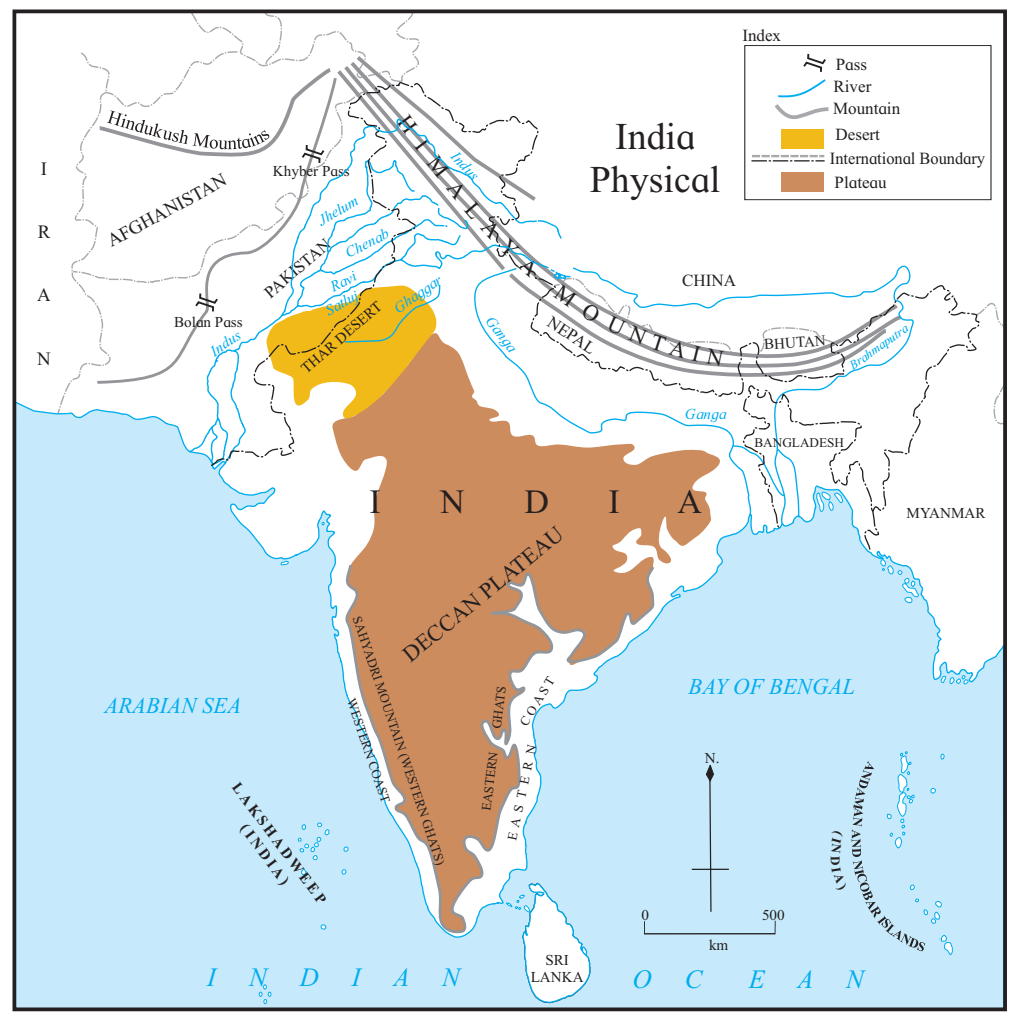
🗺️ Explanation of the Physical Map of India
🌟 Simple Explanation
This physical map shows India’s important natural landforms, rivers, surrounding water bodies and neighbouring countries. Different colours and symbols help us identify mountains, rivers, passes, deserts, plateaus and international boundaries.
📚 Meanings
| Meanings | मराठी अर्थ | हिंदी अर्थ |
|---|---|---|
| Physical map – a map showing natural features of land and water. | भौतिक नकाशा – जमीन आणि पाण्याची नैसर्गिक वैशिष्ट्ये दाखवणारा नकाशा. | भौतिक मानचित्र – भूमि और जल की प्राकृतिक विशेषताएँ दिखाने वाला मानचित्र. |
| Index – a key explaining the symbols used on a map. | सूची किंवा संकेतसूची – नकाशातील चिन्हांचा अर्थ सांगणारी सूची. | संकेत सूची – मानचित्र में उपयोग किए गए चिन्हों का अर्थ बताने वाली सूची. |
| Pass – a route through or between mountains. | खिंड – पर्वतांमधून जाणारा मार्ग. | दर्रा – पहाड़ों के बीच से जाने वाला मार्ग. |
| River – a large natural stream of flowing water. | नदी – वाहत्या पाण्याचा मोठा नैसर्गिक प्रवाह. | नदी – बहते पानी की बड़ी प्राकृतिक धारा. |
| Mountain – a very high natural area of land. | पर्वत – नैसर्गिकरीत्या उंच असलेला भूभाग. | पर्वत – प्राकृतिक रूप से बहुत ऊँचा भूभाग. |
| Desert – a very dry area receiving little rainfall. | वाळवंट – फार कमी पाऊस पडणारा कोरडा प्रदेश. | मरुस्थल – बहुत कम वर्षा वाला सूखा क्षेत्र. |
| International boundary – a line separating two countries. | आंतरराष्ट्रीय सीमा – दोन देशांना वेगळे करणारी सीमा. | अंतरराष्ट्रीय सीमा – दो देशों को अलग करने वाली सीमा. |
| Plateau – a large raised area of mostly flat land. | पठार – उंचावलेला व बहुतांश सपाट असलेला मोठा भूभाग. | पठार – ऊँचा और अधिकतर समतल बड़ा भूभाग. |
| Coast – the land beside a sea or ocean. | किनारा – समुद्र किंवा महासागरालगतचा भूभाग. | तट – समुद्र या महासागर के पास की भूमि. |
💡 Useful Information
The map’s index explains what each colour, line and symbol means. The north arrow shows direction, while the scale shows the distance represented on the map.
🎯 Clear Concept
India has mountains, passes, rivers, a desert, a large plateau, long coasts and islands. These different physical features clearly show India’s geographical diversity.