
GRADE 6 • HISTORY • SSC MAHARASHTRA STATE BOARD
Chapter 2: Prehistoric Period
Page 13 — Easy Page-wise Explanation
⚒️ 2.4 Chalcolithic Age
📜 Copper, Stone Tools and the Wheel
🌟 Simple Explanation
- Humans discovered how to use copper during this period.
- However, they did not completely stop using stone tools.
- They used tools made from both copper and stone.
- Therefore, the period is called the Chalcolithic Age or Copper-Stone Age.
- The wheel was invented during the Chalcolithic Age.
- The wheel made transportation faster.
- It also made the movement of people and goods more convenient.
- Larger areas of land were brought under cultivation during this period.
| Meanings | मराठी अर्थ | हिंदी अर्थ |
|---|---|---|
| Copper – a reddish-brown metal. | तांबे – लालसर तपकिरी रंगाचा धातू. | ताँबा – लाल-भूरे रंग की धातु. |
| Remained in use – continued to be used. | वापरात राहिले – वापरणे पुढेही सुरू राहिले. | उपयोग में रहे – जिनका उपयोग आगे भी जारी रहा. |
| Designated – given a particular name. | नाव देण्यात आले – विशिष्ट नावाने ओळखले गेले. | नाम दिया गया – किसी विशेष नाम से पहचाना गया. |
| Transportation – movement of people or goods between places. | वाहतूक – लोक किंवा वस्तू एका ठिकाणाहून दुसरीकडे नेणे. | परिवहन – लोगों या वस्तुओं को एक स्थान से दूसरे स्थान तक ले जाना. |
| Convenient – easy and useful. | सोयीस्कर – सोपे आणि उपयोगी. | सुविधाजनक – आसान और उपयोगी. |
| Cultivation – preparing land and growing crops. | लागवड – जमीन तयार करून पिके वाढवणे. | खेती – भूमि तैयार करके फसल उगाना. |
💡 Useful Information
“Chalcolithic” refers to the period when both copper and stone tools were used.
🎯 Clear Concept
Copper, stone tools, the wheel and large-scale cultivation were important features of the Chalcolithic Age.
📜 Trade, Skilled Occupations and Urbanisation
🌟 Simple Explanation
- Improved transportation made carrying goods easier.
- Because goods could be transported more easily, trade expanded.
- Trade with distant places increased during the Chalcolithic Age.
- Occupations requiring special skills also developed.
- Carpentry and metalworking were important examples.
- Trade centres emerged and gradually became larger.
- The growth of trade centres marked the beginning of urbanisation.
| Meanings | मराठी अर्थ | हिंदी अर्थ |
|---|---|---|
| Expansion – growth or increase in size. | विस्तार – आकार किंवा प्रमाणात वाढ. | विस्तार – आकार या मात्रा में वृद्धि. |
| Distant trade – trade with places located far away. | दूरचा व्यापार – दूर असलेल्या प्रदेशांशी होणारा व्यापार. | दूरस्थ व्यापार – दूर स्थित क्षेत्रों के साथ होने वाला व्यापार. |
| Skill-based occupations – jobs requiring special abilities. | कौशल्याधारित व्यवसाय – विशेष कौशल्यांची गरज असलेले व्यवसाय. | कौशल-आधारित व्यवसाय – विशेष कौशल की आवश्यकता वाले काम. |
| Carpentry – the skill of making objects from wood. | सुतारकाम – लाकडापासून वस्तू तयार करण्याचे कौशल्य. | बढ़ईगिरी – लकड़ी से वस्तुएँ बनाने का कौशल. |
| Metalworking – making objects by shaping metal. | धातुकाम – धातूला आकार देऊन वस्तू तयार करणे. | धातु-कर्म – धातु को आकार देकर वस्तुएँ बनाना. |
| Urbanisation – the development and growth of towns. | नागरीकरण – नगरांचा विकास आणि विस्तार होण्याची प्रक्रिया. | नगरीकरण – नगरों के विकास और विस्तार की प्रक्रिया. |
🎯 Clear Concept
Better transportation expanded trade, developed skilled occupations and led towards urbanisation.
📜 Crops, Hunting, Fishing and Animal Husbandry
🌟 Simple Explanation
- Chalcolithic people cultivated several kinds of crops.
- These crops included wheat, sorghum or jowar, rice, pulses and cotton.
- They sometimes hunted animals and caught fish.
- However, hunting and fishing were not their main sources of food and livelihood.
- Agriculture was their primary activity.
- Animal husbandry was practised as an additional activity.
- Keeping and caring for animals became an important part of their daily lives.
| Meanings | मराठी अर्थ | हिंदी अर्थ |
|---|---|---|
| Sorghum – a cereal crop also called jowar. | ज्वारी – धान्याचे एक पीक. | ज्वार – अनाज की एक फसल. |
| Pulses – edible dried seeds such as gram and lentils. | कडधान्ये – हरभरा आणि डाळींसारख्या खाण्यायोग्य सुक्या बिया. | दालें – चना और मसूर जैसे खाने योग्य सूखे बीज. |
| Occasionally – sometimes, but not regularly. | कधीकधी – नियमितपणे नाही, पण काही वेळा. | कभी-कभी – नियमित रूप से नहीं, पर कुछ अवसरों पर. |
| Means of subsistence – ways of obtaining food and basic needs. | उदरनिर्वाहाचे साधन – अन्न आणि मूलभूत गरजा मिळवण्याचे मार्ग. | जीविका के साधन – भोजन और मूल आवश्यकताएँ प्राप्त करने के तरीके. |
| Animal husbandry – keeping, caring for and raising animals. | पशुपालन – प्राणी पाळणे, त्यांची काळजी घेणे आणि वाढवणे. | पशुपालन – पशुओं को पालना, उनकी देखभाल करना और बढ़ाना. |
| Integral part – an important and necessary part. | अविभाज्य भाग – महत्त्वाचा आणि आवश्यक भाग. | अभिन्न अंग – महत्त्वपूर्ण और आवश्यक भाग. |
💡 Useful Information
Agriculture was the primary means of subsistence. Hunting, fishing and animal husbandry supported it as additional activities.
🎯 Clear Concept
Chalcolithic life was mainly agricultural, with animal husbandry as an important support.
📜 Burial Practices
🌟 Simple Explanation
- Chalcolithic people followed particular burial practices.
- Burials were sometimes made inside the home.
- They were also made within the courtyard.
- Archaeologists sometimes find objects used in daily life at burial sites.
- Some pottery is also found at these sites.
- These findings help researchers understand the customs of Chalcolithic people.
| Meanings | मराठी अर्थ | हिंदी अर्थ |
|---|---|---|
| Buried – placed respectfully in the ground after death. | दफन केले – मृत्यूनंतर आदराने जमिनीत ठेवले. | दफनाया गया – मृत्यु के बाद सम्मानपूर्वक जमीन में रखा गया. |
| Courtyard – an open area beside or inside a home. | अंगण – घराच्या आत किंवा शेजारील मोकळी जागा. | आँगन – घर के अंदर या पास का खुला स्थान. |
| Burial sites – places where burials were carried out. | दफनस्थळे – ज्या ठिकाणी दफनविधी करण्यात आला ती ठिकाणे. | दफन स्थल – वे स्थान जहाँ दफन किया गया. |
🎯 Clear Concept
Burial sites and the objects found there reveal Chalcolithic customs.
🏺 2.5 Excavation Sites in Maharashtra
📜 Chalcolithic Sites Along Maharashtra’s Rivers
🌟 Simple Explanation
- Several Chalcolithic sites have been found in Maharashtra.
- Many of these sites are situated along riverbanks.
- The rivers mentioned are the Tapi, Godavari, Krishna, Bhima and Pravara.
- Archaeologists conducted excavations at these sites.
- They found stone tools and different kinds of pottery.
- They also found objects made from copper.
- Large, handmade jars used for storage were also discovered.
| Meanings | मराठी अर्थ | हिंदी अर्थ |
|---|---|---|
| Associated with – connected with something. | संबंधित – एखाद्या गोष्टीशी जोडलेले. | संबंधित – किसी चीज से जुड़ा हुआ. |
| Excavations – careful digging to find objects from the past. | उत्खनन – प्राचीन वस्तू शोधण्यासाठी केलेले काळजीपूर्वक खोदकाम. | खुदाई – प्राचीन वस्तुएँ खोजने के लिए सावधानी से किया गया खोदकाम. |
| Pottery – pots and other objects made from clay. | मातीची भांडी – मातीपासून तयार केलेली भांडी व वस्तू. | मिट्टी के बर्तन – मिट्टी से बनाई गई वस्तुएँ और बर्तन. |
| Storage jars – large containers used for keeping materials safely. | साठवणीची रांजणे – वस्तू सुरक्षित ठेवण्यासाठी वापरलेली मोठी भांडी. | भंडारण के मटके – वस्तुएँ सुरक्षित रखने के लिए उपयोग किए गए बड़े पात्र. |
💡 Useful Information
Excavated tools, pottery, copper objects and storage jars help archaeologists understand Chalcolithic settlements.
🎯 Clear Concept
Important Chalcolithic settlements developed along the riverbanks of Maharashtra.
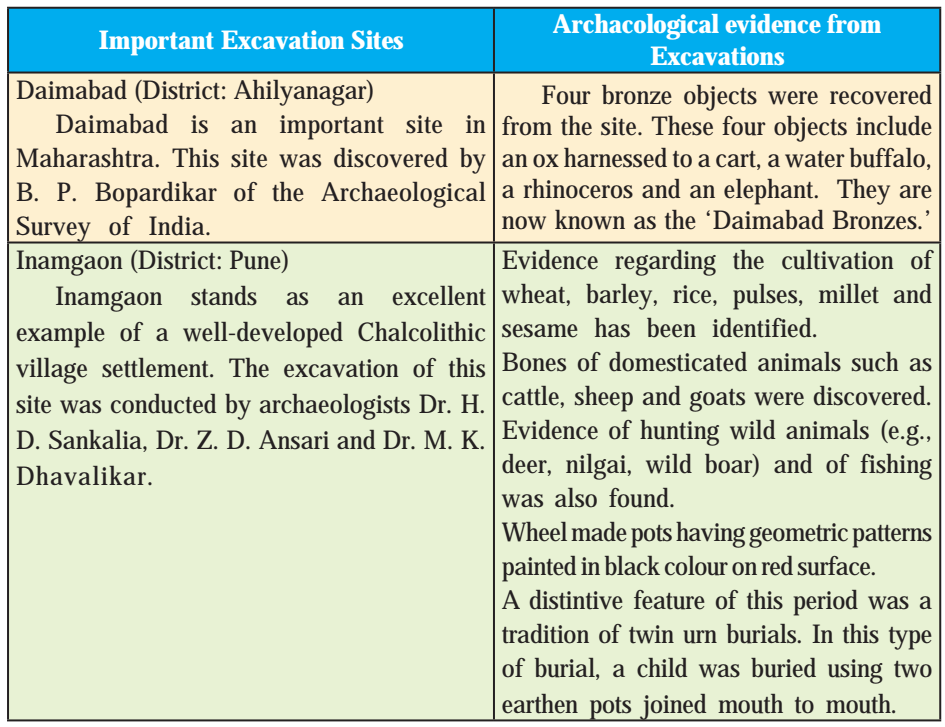
🏺 Explanation of the Excavation Table
🌟 What Does the Table Show?
The table connects important Chalcolithic excavation sites with the archaeological evidence found at each place. The portion visible on page 13 describes Daimabad and Inamgaon.
📍 Daimabad — District Ahilyanagar
- Daimabad is an important archaeological site in Maharashtra.
- B. P. Bopardikar of the Archaeological Survey of India discovered the site.
- Four bronze objects were recovered there.
- They represent an ox attached to a cart, a water buffalo, a rhinoceros and an elephant.
- These four objects are collectively known as the Daimabad Bronzes.
📍 Inamgaon — District Pune
- Inamgaon is an excellent example of a developed Chalcolithic village settlement.
- Its excavation was conducted by Dr. H. D. Sankalia, Dr. Z. D. Ansari and Dr. M. K. Dhavalikar.
- Evidence of wheat, barley, rice, pulses, millet and sesame cultivation was identified.
- Bones of domesticated cattle, sheep and goats were discovered.
- Evidence of hunting deer, nilgai and wild boar was also found.
- The discoveries also provided evidence of fishing.
- Wheel-made pots had geometric patterns painted in black on their red surfaces.
- The table also records a twin-urn burial tradition using two joined earthen pots.
| Meanings | मराठी अर्थ | हिंदी अर्थ |
|---|---|---|
| Archaeological evidence – objects and remains that provide information about the past. | पुरातत्त्वीय पुरावा – भूतकाळाची माहिती देणाऱ्या वस्तू आणि अवशेष. | पुरातात्त्विक प्रमाण – अतीत की जानकारी देने वाली वस्तुएँ और अवशेष. |
| Bronze objects – objects made from the metal called bronze. | कांस्य वस्तू – कांस्य धातूपासून तयार केलेल्या वस्तू. | काँसे की वस्तुएँ – काँसा धातु से बनाई गई वस्तुएँ. |
| Harnessed – tied or fitted to pull a cart. | जुंपलेला – गाडी ओढण्यासाठी बांधलेला. | जोता हुआ – गाड़ी खींचने के लिए बाँधा गया. |
| Village settlement – an organised place where a village community lives. | ग्रामवस्ती – गावातील लोक एकत्र राहतात अशी संघटित वस्ती. | ग्राम बस्ती – वह संगठित स्थान जहाँ गाँव का समुदाय रहता है. |
| Identified – recognised or correctly found. | ओळखले गेले – योग्य प्रकारे शोधून ओळखले गेले. | पहचाना गया – सही रूप से खोजकर पहचान की गई. |
| Geometric patterns – designs made from lines and shapes. | भौमितिक नक्षी – रेषा आणि आकारांपासून तयार केलेले नमुने. | ज्यामितीय नमूने – रेखाओं और आकृतियों से बने डिज़ाइन. |
| Twin urn burial – a burial custom using two joined earthen pots. | द्विकुंभ दफन – दोन मातीची भांडी जोडून केलेली दफनपद्धती. | दो कलशों वाला दफन – दो मिट्टी के बर्तनों को जोड़कर की गई दफन प्रथा. |
💡 Useful Information
Archaeological evidence from Daimabad and Inamgaon provides information about metal objects, farming, domesticated animals, hunting, fishing, pottery, settlements and burial customs.
🎯 Clear Concept
Excavated objects help archaeologists reconstruct the daily life and culture of Chalcolithic communities.