
GRADE 6 • HISTORY • SSC MAHARASHTRA STATE BOARD
Chapter 2: Prehistoric Period
Page 12 — Easy Page-wise Explanation
🪨 Neolithic Age
📜 Development of the Neolithic Axe
🌟 Simple Explanation
- Tool-making methods developed further during the Neolithic Age.
- Humans made a new type of stone tool called an axe.
- Axe-shaped blades had also been made during the Palaeolithic Age.
- However, the new Neolithic axe blade was polished and smoother.
- Humans developed a method of fixing the stone axe blade firmly onto a handle.
- The method of attaching a blade to a handle is called hafting.
- This Neolithic axe became an early model of the modern axe.
| Meanings | मराठी अर्थ | हिंदी अर्थ |
|---|---|---|
| Technique – a particular method of doing or making something. | तंत्र – एखादी गोष्ट करण्याची किंवा तयार करण्याची पद्धत. | तकनीक – किसी कार्य को करने या वस्तु बनाने की विधि. |
| Resembling – looking similar to something. | सारखे दिसणारे – एखाद्या गोष्टीसारखे रूप असलेले. | समान दिखने वाले – किसी वस्तु के जैसा दिखाई देना. |
| Axe blade – the sharp cutting part of an axe. | कुऱ्हाडीचे पाते – कुऱ्हाडीचा धारदार कापणारा भाग. | कुल्हाड़ी का फल – कुल्हाड़ी का धारदार काटने वाला भाग. |
| Polished – rubbed until smooth and properly finished. | घासून गुळगुळीत केलेले – घासून नीट आणि सपाट केलेले. | घिसकर चिकना किया हुआ – रगड़कर अच्छी तरह चिकना बनाया गया. |
| Hafting – fixing a stone blade firmly onto a handle. | दांडी बसवणे – दगडी पाते दांड्यावर घट्ट बसवणे. | हत्था लगाना – पत्थर के फल को हत्थे पर मजबूती से लगाना. |
| Prototype – an early model of a later tool or object. | प्रारंभिक नमुना – नंतरच्या वस्तूचा सुरुवातीचा नमुना. | प्रारम्भिक नमूना – बाद में बनी वस्तु का शुरुआती रूप. |
💡 Useful Information
The important improvement was not only polishing the stone blade but also fixing it firmly onto a handle.
🎯 Clear Concept
The polished and hafted Neolithic axe was an early form of the modern axe.
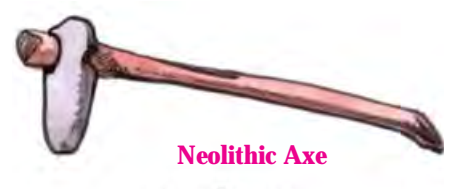
🖼️ Explanation of the Neolithic Axe
🌟 Simple Image Explanation
The image shows a Neolithic axe. A polished stone blade is fitted onto a long wooden handle. The handle would make the tool easier to hold and use.
🎯 Clear Concept
The Neolithic axe combined a polished stone blade with a wooden handle.
📜 Development of Agricultural Technology
🌟 Simple Explanation
- Agricultural technology made important progress during the Neolithic Age.
- During the earlier Mesolithic Age, humans had learnt to collect naturally growing crops.
- During the Neolithic Age, humans began sowing grains themselves.
- They sowed the grains during seasons suitable for growing them.
- Agriculture required several operations, beginning with sowing and ending with harvesting.
- Humans had to remain in one place while completing these agricultural activities.
- They gradually began staying in the same place for longer periods.
- This settled agricultural life led to the emergence of village settlements.
| Meanings | मराठी अर्थ | हिंदी अर्थ |
|---|---|---|
| Agricultural technology – methods and skills used in farming. | कृषी तंत्रज्ञान – शेतीसाठी वापरल्या जाणाऱ्या पद्धती आणि कौशल्ये. | कृषि तकनीक – खेती में उपयोग होने वाली विधियाँ और कौशल. |
| Natural crops – crops growing naturally without planned sowing. | नैसर्गिक पिके – नियोजित पेरणीशिवाय नैसर्गिकरीत्या वाढणारी पिके. | प्राकृतिक फसलें – योजनाबद्ध बुआई के बिना प्राकृतिक रूप से उगने वाली फसलें. |
| Sowing – putting seeds into the soil. | पेरणी – जमिनीत बियाणे टाकणे. | बुआई – मिट्टी में बीज डालना. |
| Appropriate seasons – seasons suitable for a particular activity. | योग्य ऋतू – एखाद्या कामासाठी अनुकूल असलेले ऋतू. | उचित ऋतुएँ – किसी कार्य के लिए उपयुक्त मौसम. |
| Harvesting – collecting fully grown crops. | पीक कापणी – तयार झालेले पीक कापून गोळा करणे. | फसल कटाई – तैयार फसल को काटकर इकट्ठा करना. |
| Village settlements – organised places where groups of people live permanently. | गावांच्या वस्त्या – लोकांचे समूह कायमस्वरूपी राहतात अशी संघटित ठिकाणे. | ग्राम बस्तियाँ – वे संगठित स्थान जहाँ लोग स्थायी रूप से समूह में रहते हैं. |
💡 Useful Information
Farming required humans to care for crops from sowing until harvesting. Therefore, they could no longer keep moving continuously.
🎯 Clear Concept
Agriculture encouraged humans to remain in one place and establish villages.
🌟 Simple Explanation of the Activity
Compare the tools, food, shelter, occupations and way of life of humans during the Palaeolithic, Mesolithic and Neolithic periods.
✅ Textbook-based Comparative Chart
| Feature | Palaeolithic Age | Mesolithic Age | Neolithic Age |
|---|---|---|---|
| Tools | Rough stone tools used for hunting, scraping and digging. | Smaller stone tools; sharp tools made by grinding and polishing horns and bones. | Polished stone axe blades fixed onto wooden handles. |
| Shelter | Caves or branches of large trees. | Natural caves, rock shelters and temporary seasonal camps. | Permanent settlements and villages. |
| Food-related activities | Hunting and dependence upon nature. | Hunting, fishing and harvesting natural crops. | Sowing grains, harvesting crops and producing food grains and milk. |
| Animals | The textbook paragraph does not mention domestication in this period. | Dogs, goats and sheep were domesticated; the dog was first. | Animals were domesticated and used for work and carrying heavy loads. |
| Way of life | Completely dependent upon nature. | Transition from nomadic life towards settled life. | Settled agricultural life in villages near fertile riverbanks. |
| Important developments | Use of fire. | Smaller tools, fishing and animal domestication. | Agriculture, food storage, pottery, weaving and wooden-boat navigation. |
📜 Invention of Agriculture and Cultivation
🌟 Simple Explanation
- The invention of agriculture was an important Neolithic development.
- Humans developed methods for producing food grains and milk.
- The textbook credits women with beginning cultivation.
- Women may have used pointed sticks to place seeds in the soil.
- To make the stick dig more deeply into the soil, an additional improvement was made.
- The explanation of this improvement continues after the textbook image.
| Meanings | मराठी अर्थ | हिंदी अर्थ |
|---|---|---|
| Invention – the creation of a new method or thing. | शोध – नवीन पद्धत किंवा वस्तू तयार करणे. | आविष्कार – नई विधि या वस्तु का निर्माण. |
| Production – the process of growing or making something. | उत्पादन – एखादी गोष्ट तयार किंवा पिकवण्याची प्रक्रिया. | उत्पादन – किसी वस्तु को बनाने या उगाने की प्रक्रिया. |
| Credited – recognised as responsible for something. | श्रेय दिले – एखाद्या कामासाठी जबाबदार मानले. | श्रेय दिया – किसी कार्य के लिए उत्तरदायी माना गया. |
| Cultivation – preparing land and growing crops. | शेती – जमीन तयार करून पिके वाढवणे. | खेती – भूमि तैयार करके फसल उगाना. |
| Pointed sticks – sticks having sharp ends. | टोकदार काठ्या – धारदार किंवा निमुळते टोक असलेल्या काठ्या. | नुकीली लकड़ियाँ – तेज या नुकीले सिरे वाली लकड़ियाँ. |
🎯 Clear Concept
Pointed sticks were an early agricultural tool used for sowing seeds.
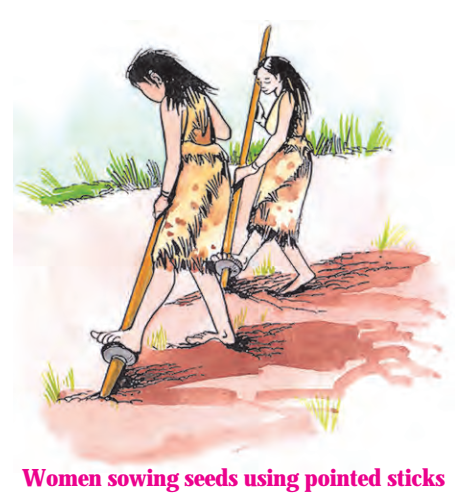
🖼️ Explanation of the Sowing-Seeds Image
🌟 Simple Image Explanation
- The image shows two women working in cultivated soil.
- They are using long pointed sticks to sow seeds.
- A stone weight is fixed near the lower part of each stick.
- The added weight helps the pointed stick enter more deeply into the soil.
🎯 Clear Concept
Weighted pointed sticks made it easier to place seeds deeper in the soil.
📜 Agriculture, Food Storage and Innovation
🌟 Simple Explanation
- A perforated stone was fixed to the pointed stick to add weight.
- The added weight helped the stick dig deeper into the soil.
- The textbook states that women in some tribes still use this sowing method.
- A regular supply of food grains became available through agriculture.
- Because their food needs could be met, humans stopped wandering continuously.
- Agriculture gave human life greater stability.
- Harvested grains could be stored for longer periods.
- People began producing more food than they immediately needed.
- This extra food is called a surplus.
- Some group members now had time to think about new ideas.
- They developed new skills through innovation and creativity.
- This stability helped humans make progress in many different fields.
| Meanings | मराठी अर्थ | हिंदी अर्थ |
|---|---|---|
| Perforated stone – a stone having a hole through it. | छिद्र असलेला दगड – ज्यामध्ये आरपार भोक केलेले आहे असा दगड. | छेद वाला पत्थर – ऐसा पत्थर जिसमें आर-पार छेद हो. |
| Steady supply – a regular and dependable amount. | नियमित पुरवठा – सातत्याने आणि विश्वासाने मिळणारे प्रमाण. | नियमित आपूर्ति – लगातार और भरोसेमंद रूप से मिलने वाली मात्रा. |
| Constant wandering – continuously moving from place to place. | सतत भटकंती – एका ठिकाणाहून दुसरीकडे सतत फिरत राहणे. | लगातार भटकना – एक स्थान से दूसरे स्थान पर निरंतर घूमना. |
| Surplus quantity – an amount greater than what is needed. | अतिरिक्त प्रमाण – गरजेपेक्षा जास्त असलेले प्रमाण. | अतिरिक्त मात्रा – आवश्यकता से अधिक मात्रा. |
| Innovation – developing a new idea or method. | नवकल्पना – नवीन विचार किंवा पद्धत विकसित करणे. | नवाचार – नया विचार या तरीका विकसित करना. |
| Creativity – the ability to produce new ideas. | सर्जनशीलता – नवीन कल्पना निर्माण करण्याची क्षमता. | रचनात्मकता – नए विचार उत्पन्न करने की क्षमता. |
💡 Useful Information
Food surplus allowed people to store grains and spend time developing other skills and new ideas.
🎯 Clear Concept
Agriculture provided food security, stability, surplus production and time for innovation.
📜 Animals, Pottery, Weaving and Boats
🌟 Simple Explanation
- Humans learnt to domesticate animals along with developing agriculture.
- Some domesticated animals were used for difficult physical work.
- Animals were also used for carrying heavy loads.
- The art of making earthen pots developed along with agriculture.
- Pots were made in different shapes and colours.
- People decorated the pots with beautiful artistic designs.
- People also mastered the skill of weaving during this period.
- Neolithic humans learnt how to navigate wooden boats.
| Meanings | मराठी अर्थ | हिंदी अर्थ |
|---|---|---|
| Earthen pots – pots made from clay or earth. | मातीची भांडी – मातीपासून तयार केलेली भांडी. | मिट्टी के बर्तन – मिट्टी से बनाए गए बर्तन. |
| Artistic designs – attractive patterns made using creative skill. | कलात्मक नक्षी – सर्जनशील कौशल्याने तयार केलेले सुंदर नमुने. | कलात्मक डिज़ाइन – रचनात्मक कौशल से बनाए गए सुंदर नमूने. |
| Weaving – making cloth by crossing threads together. | विणकाम – धागे एकमेकांत गुंफून कापड तयार करणे. | बुनाई – धागों को एक-दूसरे में पिरोकर कपड़ा बनाना. |
| Mastered – learnt a skill very well. | प्रभुत्व मिळवले – एखादे कौशल्य खूप चांगल्या प्रकारे शिकले. | निपुणता प्राप्त की – किसी कौशल को बहुत अच्छी तरह सीखा. |
| Navigating – directing and controlling a boat’s movement. | नौकानयन – नौकेची दिशा आणि हालचाल नियंत्रित करणे. | नौकायन – नाव की दिशा और गति को नियंत्रित करना. |
🎯 Clear Concept
Neolithic humans developed animal domestication, pottery, weaving and wooden-boat navigation.
📜 Settled Life and the Family
🌟 Simple Explanation
- Agriculture continued to advance during the Neolithic Age.
- People began settling in fertile areas near riverbanks.
- These fertile regions were suitable for agriculture.
- People stopped following a nomadic way of life.
- Their wandering life came to an end as they settled permanently.
- The institution of the family began taking shape during this settled period.
| Meanings | मराठी अर्थ | हिंदी अर्थ |
|---|---|---|
| Advancement – further development or progress. | प्रगती – पुढील विकास किंवा सुधारणा. | उन्नति – आगे का विकास या सुधार. |
| Fertile regions – areas having soil suitable for growing crops. | सुपीक प्रदेश – पिके वाढवण्यासाठी योग्य माती असलेले भाग. | उपजाऊ क्षेत्र – फसल उगाने योग्य मिट्टी वाले स्थान. |
| Riverbanks – land along the sides of rivers. | नदीकाठ – नदीच्या बाजूचा भूभाग. | नदी के किनारे – नदी के दोनों ओर की भूमि. |
| Institution of family – the organised social system of family life. | कुटुंबसंस्था – कुटुंबाच्या रूपातील संघटित सामाजिक व्यवस्था. | परिवार संस्था – परिवार के रूप में संगठित सामाजिक व्यवस्था. |
| Take shape – to begin developing into a clear form. | आकार घेणे – स्पष्ट स्वरूपात विकसित होण्यास सुरुवात होणे. | आकार लेना – स्पष्ट रूप में विकसित होना शुरू करना. |
💡 Useful Information
Fertile riverbanks supplied suitable land for farming. This encouraged permanent settlements and stable family life.
🎯 Clear Concept
Agriculture ended nomadic life and encouraged permanent settlements and the development of families.