
Harappan Civilisation
Chapter 3 · Maharashtra Board · Textbook Page 20
performed within the Great Bath complex and its immediate vicinity. The Great Bath consists of a large water tank measuring approximately 12 meters in length, 7 meters in width and 2.5 meters in depth. It was constructed using baked bricks. Special technique was employed to regulate the inflow and outflow of water in the tank. The tank was surrounded by a series of small rooms.
Simple Explanation
The previous page began a sentence about religious rituals. This page continues that sentence by saying that the rituals were performed within the Great Bath complex and its immediate vicinity, meaning the area around the Great Bath.
The Great Bath was a large water tank. It was approximately 12 metres long, 7 metres wide and 2.5 metres deep.
The Great Bath was constructed using baked bricks.
A special technique was used to control the water entering the tank and the water leaving the tank. These are called the inflow and outflow of water.
The tank was surrounded by a series of small rooms.
| Meanings | Marathi Arth | Hindi Arth |
|---|---|---|
| Performed — carried out or done | केले गेले | किए गए |
| Complex — a group of connected buildings or structures | संकुल | परिसर / संकुल |
| Vicinity — nearby area | आजूबाजूचा परिसर | आसपास का क्षेत्र |
| Measuring — having a particular size | मोजमाप असलेले | माप वाला |
| Depth — distance from top to bottom | खोली | गहराई |
| Regulate — control or manage | नियंत्रित करणे | नियंत्रित करना |
| Inflow — movement of water into a place | पाण्याचा आत येणारा प्रवाह | अंदर आने वाला जल प्रवाह |
| Outflow — movement of water out of a place | पाण्याचा बाहेर जाणारा प्रवाह | बाहर जाने वाला जल प्रवाह |
Dietary Habits
Wheat, barley, peas, sesame seeds, finger millet (Ragi), lentils and various types of pulses formed staple diet of the people. Archaeological evidence suggests that milk, meat and fish were also consumed in certain regions. Earthen pottery was used for cooking. Some of the Harappan pottery featured painted designs and decorative motifs. These motifs were painted in black on a red-colored background. The decorative motifs include symbols such as fish scales, intersecting circles, Pipal leaves etc.
Simple Explanation
The main food, or staple diet, of the Harappan people included wheat, barley, peas, sesame seeds, finger millet (Ragi), lentils and different types of pulses.
Archaeological evidence shows that in some regions, people also consumed milk, meat and fish.
The Harappan people used earthen pottery for cooking.
Some Harappan pottery had painted designs and decorative motifs.
These decorative designs were painted in black colour on a red-coloured background.
The designs included symbols such as fish scales, intersecting circles and Pipal leaves.
| Meanings | Marathi Arth | Hindi Arth |
|---|---|---|
| Dietary — related to food and eating | आहाराशी संबंधित | आहार संबंधी |
| Staple diet — main food regularly eaten | मुख्य आहार | मुख्य आहार |
| Sesame seeds — small seeds used as food and oil | तीळ | तिल |
| Finger millet — a type of millet, also called Ragi | नाचणी | रागी / मंडुआ |
| Lentils — edible dried seeds of certain plants | मसूर डाळ | मसूर दाल |
| Pulses — edible dried seeds such as dals | कडधान्ये | दलहन |
| Archaeological evidence — evidence obtained from remains of the past | पुरातत्त्वीय पुरावा | पुरातात्त्विक साक्ष्य |
| Consumed — eaten or used as food | सेवन केले | सेवन किया |
| Earthen pottery — pots made from baked clay | मातीची भांडी | मिट्टी के बर्तन |
| Decorative motifs — designs used for decoration | सजावटीच्या आकृत्या | सजावटी की आकृतियाँ |
| Intersecting — crossing one another | एकमेकांना छेदणारे | एक-दूसरे को काटने वाले |
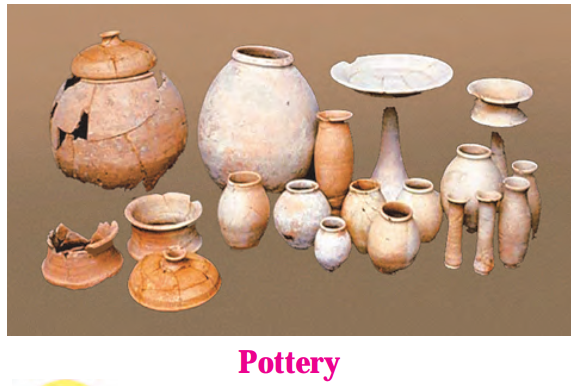
Discuss in class, which of the following grains wheat, gram, rice, barley, lentils, black gram, millet, etc. were present during the Harappan period.
Clothing Style and Ornaments:
The clothing style and ornaments of the Harappan people provide insights into the technology, aesthetic sensibilities and lifestyle of those times. Harappan, people used cotton and silk garments.
Simple Explanation
The clothing and ornaments used by Harappan people help us understand their technology, sense of beauty and lifestyle.
Their clothing gives us information about the way people lived during that time.
The page states that Harappan people used cotton and silk garments.
| Meanings | Marathi Arth | Hindi Arth |
|---|---|---|
| Clothing — clothes worn by people | वस्त्र / कपडे | कपड़े / वस्त्र |
| Ornaments — decorative items worn on the body | दागिने / अलंकार | आभूषण / गहने |
| Insights — understanding gained from information | माहिती / अंतर्दृष्टी | समझ / अंतर्दृष्टि |
| Technology — knowledge and methods used to make things | तंत्रज्ञान | प्रौद्योगिकी |
| Aesthetic — related to beauty and artistic sense | सौंदर्यविषयक | सौंदर्य संबंधी |
| Sensibilities — feelings or understanding about beauty and quality | संवेदनशीलता / जाण | संवेदनशीलता / समझ |
| Garments — clothes | वस्त्रे | वस्त्र / कपड़े |
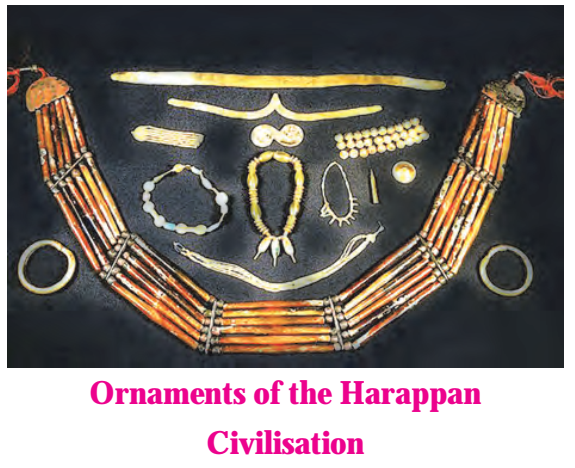
Based on archaeological evidence, one can have an idea of the attire of Harappan people. Both men and women used a knee-length skirt and an upper garment. The people of the Harappan Civilisation were highly skilled in crafting ornaments. They made beads using clay, colourful semi-precious stones, shells, copper, silver and gold. These beads were in high demand especially in Mesopotamia. The people of the Harappan Civilisation used ornaments like necklaces, earrings, armbands, bangles, rings and waistbands.
Simple Explanation
Archaeological evidence helps us understand what kind of clothes Harappan people wore.
Both men and women used a knee-length skirt and an upper garment.
The people of the Harappan Civilisation were very skilled at making ornaments.
They made beads using many materials, including clay, colourful semi-precious stones, shells, copper, silver and gold.
These beads were in high demand, especially in Mesopotamia. This means that people in Mesopotamia wanted these beads in large amounts.
Harappan people used many types of ornaments, such as necklaces, earrings, armbands, bangles, rings and waistbands.
| Meanings | Marathi Arth | Hindi Arth |
|---|---|---|
| Attire — clothes worn by a person | वेशभूषा | पहनावा / वेशभूषा |
| Knee-length — reaching up to the knee | गुडघ्यापर्यंत लांबीचे | घुटने तक लंबा |
| Garment — a piece of clothing | वस्त्र | वस्त्र / कपड़ा |
| Skilled — having good ability in something | कुशल | कुशल |
| Crafting — making something skillfully | कौशल्याने तयार करणे | कुशलता से बनाना |
| Beads — small decorative pieces used for making ornaments | मणी | मनके |
| Semi-precious stones — stones used as valuable decorative materials | अर्ध-मौल्यवान दगड | अर्ध-मूल्यवान पत्थर |
| Shells — hard outer coverings of some sea animals | शिंपले | सीपियाँ |
| In high demand — wanted by many people | मोठी मागणी असलेले | बहुत अधिक माँग वाला |
| Mesopotamia — an ancient region associated with the Tigris and Euphrates rivers | मेसोपोटेमिया | मेसोपोटामिया |
| Armband — ornament worn around the upper arm | बाजूबंद | बाजूबंद |
| Waistband — ornament or band worn around the waist | कंबरपट्टा | कमरबंद |
Occupations and Trade
The people of the Harappan Civilisation practiced agriculture and cultivated a variety of crops. Wheat and barley were their principal crops. The people of the Harappan Civilisation were familiar with cotton. Harappan artisans were engaged in various occupations, such as making various types of objects from iron, bronze, clay and gold, as well as weaving textiles. They produced exquisite pottery.
Simple Explanation
The Harappan people practiced agriculture and grew many different types of crops.
Their main or principal crops were wheat and barley.
The Harappan people were also familiar with cotton.
Harappan artisans worked in many different occupations. They made different kinds of objects using iron, bronze, clay and gold.
They also practiced weaving textiles.
They produced exquisite pottery, meaning pottery of very fine or beautiful quality.
| Meanings | Marathi Arth | Hindi Arth |
|---|---|---|
| Occupations — types of work people do | व्यवसाय / कामे | व्यवसाय / काम |
| Practiced — did or followed regularly | आचरण केले / केले | किया / अपनाया |
| Agriculture — farming | शेती / कृषी | कृषि / खेती |
| Cultivated — grew crops | लागवड केली | फसल उगाई |
| Variety — many different kinds | विविधता | विविधता / अनेक प्रकार |
| Principal — main or most important | प्रमुख / मुख्य | प्रमुख / मुख्य |
| Artisans — skilled people who make things by hand | कारागीर | कारीगर |
| Bronze — a metal made mainly from copper and tin | कांस्य | कांसा |
| Weaving — making cloth by joining threads | विणकाम | बुनाई |
| Textiles — cloth or material made from fibres | वस्त्रे / कापड | वस्त्र / कपड़ा |
| Exquisite — extremely beautiful or fine | उत्कृष्ट / सुंदर | उत्कृष्ट / सुंदर |
They were familiar with sailing, which enabled them to conduct long-distance trade.
Simple Explanation
The Harappan people knew how to sail.
Their knowledge of sailing helped them carry out trade over long distances.
| Meanings | Marathi Arth | Hindi Arth |
|---|---|---|
| Familiar — knowing about something | परिचित | परिचित |
| Sailing — travelling by boat or ship | नौकानयन / जलप्रवास | नौकायन |
| Enabled — made it possible | शक्य केले | संभव बनाया |
| Long-distance — covering a large distance | लांब पल्ल्याचा | लंबी दूरी का |
| Conduct — carry out or perform | करणे / पार पाडणे | करना / संचालित करना |
| Trade — buying, selling or exchanging goods | व्यापार | व्यापार |