Harappan Civilisation
Chapter 3 · Maharashtra Board · Textbook Page 22
used Lapis Lazuli as a symbol of her divine grandeur. Lapis Lazuli is a deep-blue semiprecious stone. In antiquity, Lapis Lazuli was considered extremely rare and precious. Mines of Lapis Lazuli are located in Afghanistan. Harappan merchants were actively engaged in the trade of this stone. It was in high demand in Mesopotamia. Goddess Inanna’s story shows, how myths form a source of history, as they reflect the social, cultural, religious and political situations.
Simple Explanation
This is the continuation of the information about Goddess Inanna from Page 21. She used Lapis Lazuli as a symbol of her divine grandeur.
Lapis Lazuli is a deep-blue semiprecious stone. In ancient times, it was considered very rare and precious.
The mines of Lapis Lazuli are located in Afghanistan.
Harappan merchants actively traded this stone. It was in high demand in Mesopotamia, which means many people there wanted this stone.
The story of Goddess Inanna also helps us understand how myths can become a source of history. Such stories can reflect the social, cultural, religious and political situations of the time.
| Meanings | Marathi Arth | Hindi Arth |
|---|---|---|
| Divine — related to a god or goddess | दैवी | दिव्य |
| Grandeur — greatness and splendour | भव्यता | भव्यता |
| Semiprecious — a stone that is valuable but not among the most precious stones | अर्ध-मौल्यवान | अर्ध-मूल्यवान |
| Antiquity — ancient times | प्राचीन काळ | प्राचीन काल |
| Rare — not commonly found | दुर्मिळ | दुर्लभ |
| Merchants — people who trade goods | व्यापारी | व्यापारी |
| Demand — desire or need for something | मागणी | माँग |
| Myths — traditional stories, often involving gods or heroes | पौराणिक कथा | पौराणिक कथाएँ |
| Reflect — show or give an idea about something | प्रतिबिंबित करणे / दर्शवणे | प्रतिबिंबित करना / दिखाना |
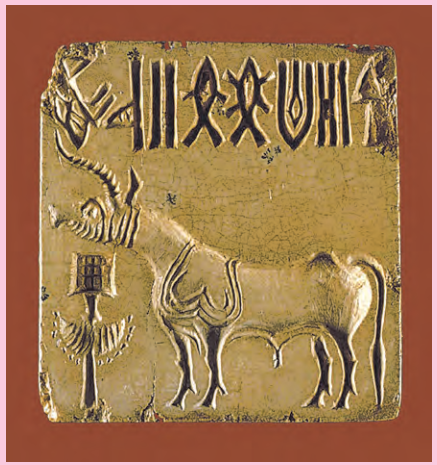
During Harappan period Lothal served as a significant port. A massive dockyard has been discovered at this site. The trade of the Harappan civilization extended along the coast of the Arabian Sea, reaching as far as the Persian Gulf. The Harappan seals were used primarily for trade purposes. These seals have animal pictures such as ox, elephant, buffalo, rhinoceros and tiger as well as human figures.
Simple Explanation
During the Harappan period, Lothal was an important port. A very large dockyard has been discovered there.
The Harappan people traded along the coast of the Arabian Sea. Their trade reached as far as the Persian Gulf.
The Harappan people mainly used seals for trade purposes.
These seals had pictures of different animals, including the ox, elephant, buffalo, rhinoceros and tiger. They also had pictures of human figures.
| Meanings | Marathi Arth | Hindi Arth |
|---|---|---|
| Significant — important | महत्त्वपूर्ण | महत्त्वपूर्ण |
| Port — a place where ships load and unload goods | बंदर | बंदरगाह |
| Dockyard — a place where ships are kept, repaired or handled | जहाजतळ | जहाजों का घाट / गोदी |
| Coast — land beside the sea | समुद्रकिनारा | समुद्र तट |
| Seals — small objects bearing pictures or inscriptions | शिक्के | मुहरें |
| Primarily — mainly | मुख्यतः | मुख्य रूप से |
Observe the Harappan seal shown in the image; it shows a mythical creature with one horn (Unicorn). Have you ever seen any such mythical creature on any object or structure?
Art and Entertainment
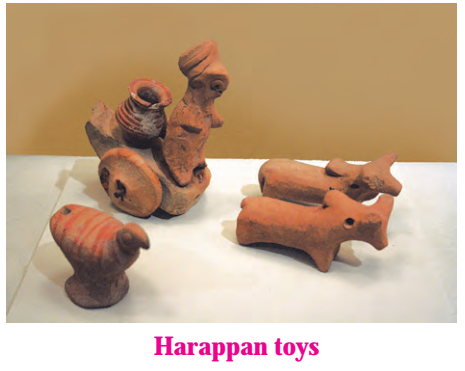
The people of the Harappan civilisation were skilled artisans. They created numerous beautiful objects using clay, metals and precious stones. A bronze figurine discovered from the Harappan civilisation is famously known as the ‘Dancing Girl’. In addition to this, the Harappan people created animal figurines, toys and seals. An important artifact of the Harappan civilisation is a distinctive statue discovered at Mohenjodaro. This statue was
Simple Explanation
The people of the Harappan civilisation were skilled artisans. Artisans are people who make things skillfully by hand.
They made many beautiful objects using clay, metals and precious stones.
One famous Harappan object is a bronze figurine called the ‘Dancing Girl’.
The Harappan people also made animal figurines, toys and seals.
Another important Harappan artefact is a distinctive statue discovered at Mohenjodaro. The description of this statue continues in the next part.
| Meanings | Marathi Arth | Hindi Arth |
|---|---|---|
| Artisans — skilled people who make things by hand | कारागीर | कारीगर |
| Numerous — many | असंख्य / अनेक | अनेक / बहुत से |
| Figurine — a small statue or figure | लहान मूर्ती | छोटी मूर्ति |
| Bronze — a metal made mainly from copper and tin | कांस्य | कांस्य |
| Distinctive — special and easily recognised | वैशिष्ट्यपूर्ण | विशिष्ट |
| Artefact — an object made or used by people in the past | पुरावस्तू | पुरावशेष / कलाकृति |
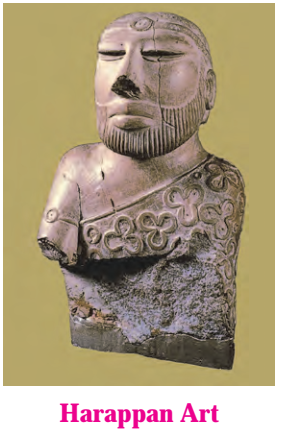
unearthed during excavations at Mohenjodaro and is currently housed in the National Museum, Delhi. It is identified as the ‘Priest-King’.
Simple Explanation
The distinctive statue was found during excavations at Mohenjodaro.
Today, the statue is kept in the National Museum, Delhi.
The statue is identified as the ‘Priest-King’.
| Meanings | Marathi Arth | Hindi Arth |
|---|---|---|
| Unearthed — discovered by digging | उत्खननातून सापडलेले | खुदाई से मिला |
| Excavations — digging to discover remains of the past | उत्खनन | उत्खनन / खुदाई |
| Housed — kept in a particular place | ठेवलेले | रखा हुआ |
| Identified — recognised or named | ओळखलेले | पहचाना गया |